
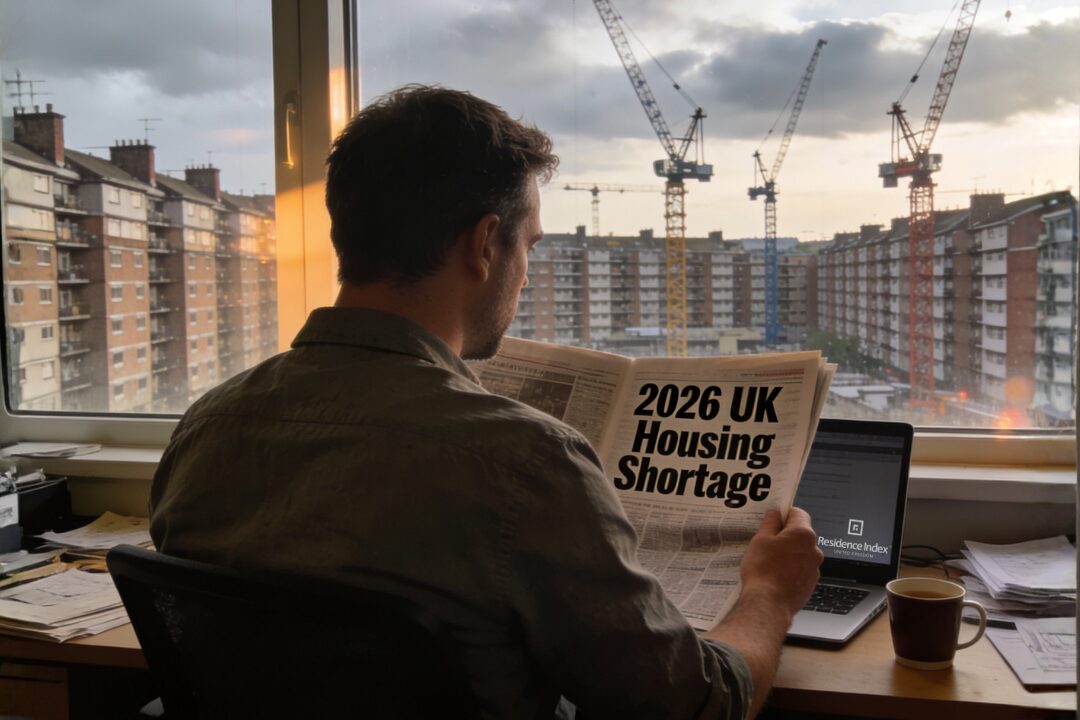
The UK Housing Shortage — Why It Isn’t Going Away
Britain Has Been “Short of Housing” for Decades — So Why Is the Problem Still Getting Worse?
The UK housing shortage is often discussed as though it were temporary.
Build more homes, reform planning, encourage development — and eventually supply catches up with demand.
But after decades of debate, the underlying shortage remains.
In many parts of the country, it is becoming more severe.
This raises a more uncomfortable possibility:
What if the housing shortage is not a short-term problem, but a structural feature of the UK economy?
Because despite changing governments, housing targets, and repeated promises of reform, the gap between supply and demand continues to persist.
📊 Britain Still Isn’t Building Enough Homes
Most housing analysts agree the UK needs to build roughly 300,000 homes per year to meet long-term demand.
Yet completions have repeatedly fallen below that level.
Data from the National House Building Council and the Office for National Statistics shows that annual housing delivery has consistently struggled to keep pace with household formation.
The result is cumulative.
A shortage in one year does not disappear in the next. It compounds over time.
This is one reason the UK housing market behaves differently from markets where supply can respond more freely to demand.
👤 Britain Needs More Homes Per Person Than Before
One of the less discussed drivers of the shortage is changing living patterns.
Britain does not simply have more people.
It also has more households relative to population size.
People are:
- Marrying later
- Having fewer children
- Living alone for longer
- Separating more frequently
According to the Office for National Statistics, single-person households have increased significantly over recent decades and now account for a large share of UK households.
This matters because housing demand is driven by households — not just population.
A country where two people occupy two homes instead of one requires materially more housing stock, even if overall population growth slows.
In other words:
The UK housing shortage is partly demographic, not just numerical.
🏗️ The Planning System Still Restricts Supply
Planning remains one of the biggest structural constraints.
The UK planning system is:
- Slow
- Politically sensitive
- Frequently opposed at local level
Development often faces resistance linked to:
- Infrastructure pressure
- Environmental concerns
- Local opposition to density
Even where land is technically available, turning it into deliverable housing stock is neither quick nor straightforward.
This creates a fundamental issue:
Housing demand can rise quickly. Housing supply in Britain usually cannot.
🏙️ Why So Little Is Being Built in London
One of the most striking features of the current market is how sharply parts of London development have slowed.
Despite persistent demand, many schemes are no longer financially viable under current conditions.
Developers are facing pressure from multiple directions simultaneously:
- Higher interest rates
- Rising construction costs
- Labour shortages
- Slower sales rates
- Affordable housing obligations
- Building Safety Regulator (BSR) delays
The introduction of stricter building safety rules following the Grenfell Tower fire has significantly increased both cost and complexity for high-rise development.
In particular, the Building Safety Regulator “Gateway” approval process has slowed many projects substantially.
At the same time, build cost inflation remains elevated. According to industry data from firms such as Savills and Knight Frank, viability pressure has become a major issue across London residential development.
The result is paradoxical:
London desperately needs more housing, yet the economics of building it have become increasingly difficult.
🧱 Britain Also Has a Construction Capacity Problem
Even if planning became easier tomorrow, the UK would still face constraints.
The construction sector continues to struggle with:
- Labour shortages
- Skills gaps
- Rising material costs
- An ageing workforce
This limits how quickly supply can expand.
Housing shortages are not solved simply by setting targets.
They require the physical capacity to build at scale.
📉 Why Higher Interest Rates Didn’t “Fix” the Market
Many expected higher interest rates to trigger a major housing correction.
Instead, the market slowed — but largely stabilised.
Why?
Because higher rates reduced affordability, but they did not solve the underlying supply imbalance.
At the same time:
- Developers slowed new projects
- Financing costs increased
- Future housing supply weakened further
In some ways, higher rates may actually have reinforced the long-term shortage.
This helps explain why prices softened in some areas without collapsing nationally.
🌍 Demand Remains Concentrated in Key Economic Areas
The housing shortage is not evenly distributed.
The strongest pressure tends to exist in areas with:
- Major employment markets
- Universities
- Infrastructure investment
- International demand
This includes much of:
- London
- The South East
- Major regional cities such as Manchester and Birmingham
These areas continue to attract both domestic and international migration, reinforcing rental and ownership demand.
🧠 The Market Is Already Adjusting
One of the clearest responses to persistent undersupply has been the growth of:
- Build-to-Rent (BTR)
- Institutional investment
- Professionally managed residential developments
Large investors increasingly recognise that long-term undersupply supports rental demand.
This partly explains why institutional capital continues to flow into UK residential property despite political and economic uncertainty.
The market is adapting to the shortage — even if the shortage itself remains unresolved.
🧠 RIUK View
In our view, the UK housing shortage is unlikely to disappear in the foreseeable future.
Not because governments are unaware of the issue, but because the constraints are structural:
- Planning complexity
- Political resistance to development
- Changing demographics
- Construction capacity limitations
- Rising development costs
- Persistent demand in economically productive cities
This does not mean all property investments perform equally well.
But it does create a long-term underpinning for well-located residential assets in areas with durable demand.
Increasingly, we are seeing investors focus less on short-term market timing and more on:
- Asset quality
- Location strength
- Tenant demand resilience
- Long-term supply dynamics
🎯 Final Thought
The UK housing shortage is often framed as a policy failure.
In reality, it is probably more complicated than that.
Britain has created a system where:
- Building is slow
- Development is expensive
- Demand keeps evolving
- And supply struggles to respond effectively
Until those structural issues change, the imbalance between housing supply and demand is unlikely to disappear.
For investors, that does not eliminate risk.
But it does help explain why UK residential property continues to retain long-term relevance — despite repeated predictions of decline.