Your search results

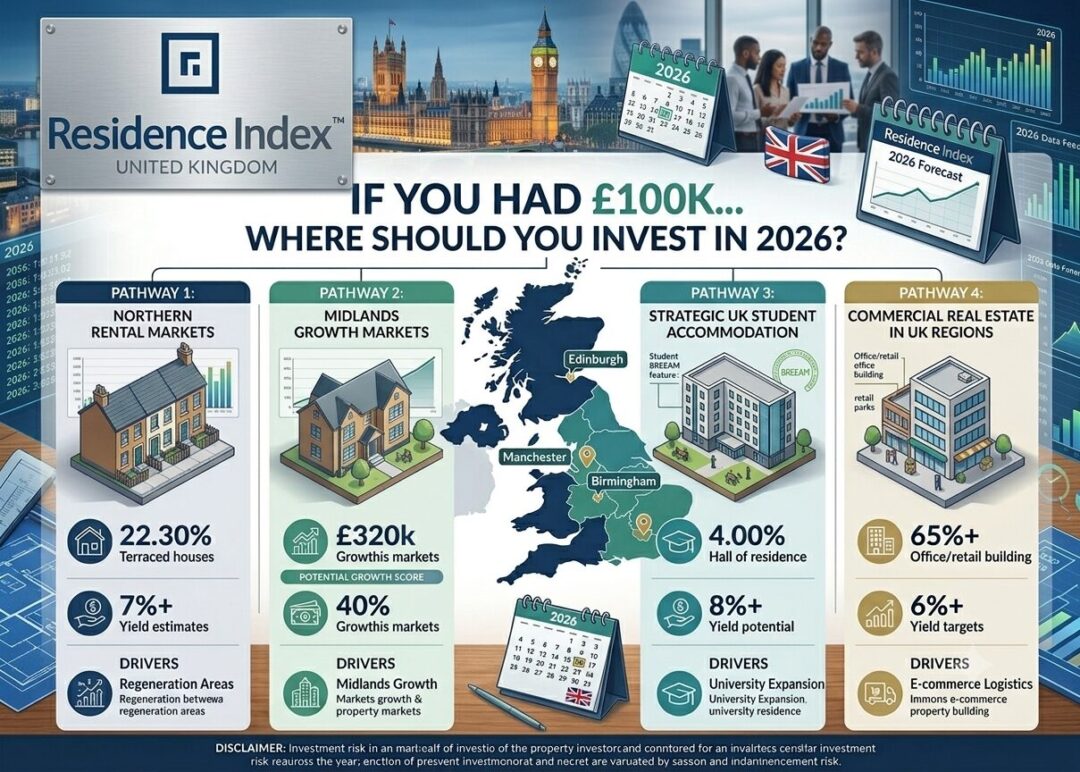
If You Had £100K… Where Should You Invest in UK Property in 2026?

Posted by residenceindexuk on May 19, 2026
0 Comments

This is one of the most common questions from new and experienced investors alike:

“If I had £100,000, where should I invest it in UK property?”

Most people expect a simple answer.

A city.
A postcode.
A “hot deal.”

But in 2026, the real answer is more strategic than that.

Because £100K is not just capital.

It’s a positioning decision.


The Mistake Most Investors Make

The instinct is to chase:

  • The cheapest entry point
  • The highest yield
  • The fastest return

But that approach often leads to:

  • Weak tenant demand
  • High void risk
  • Limited capital growth
  • Difficult resale liquidity

We explored this thinking shift in:
👉 /stop-looking-for-the-best-deal-uk-property

Because in reality, buying power should be used to build position — not just chase price.


What £100K Should Actually Do

£100K in UK property should achieve one or more of the following:

  • Secure strong rental demand
  • Minimise void risk
  • Position for capital growth
  • Maintain long-term liquidity

According to the Office for National Statistics, rental demand in major UK cities continues to outpace supply in key sectors, particularly professional and family rentals.

But demand alone is not enough.

You need the right type of demand.


Where Smart Investors Are Looking in 2026

Institutional-grade research from Savills and JLL consistently highlights regional cities with:

  • Strong employment growth
  • Infrastructure investment
  • Regeneration pipelines
  • Graduate retention

Cities such as Manchester and Birmingham continue to attract both institutional capital and private investors due to long-term fundamentals.

But here’s the key:

It’s not about the city alone.

It’s about the micro-location within the city.


Why £100K Should Not Be Treated as “Buying Power”

Too many investors treat £100K as:

“How much property can I buy?”

Instead of:

“How strong is the tenant demand for what I’m buying?”

That shift changes everything.

Because a lower-priced property in a weak area often underperforms compared to a higher-quality asset in a stronger location.

We also explored this in:
👉 /cheap-rent-wrong-tenants-uk

Cheap entry often comes with hidden long-term cost.


The Institutional Mindset

Large investors don’t ask:

  • “Where is it cheapest?”
  • “Where is the highest yield?”

They ask:

  • “Where is demand most stable?”
  • “Where will tenants stay longer?”
  • “Where is liquidity strongest at exit?”

In a higher interest rate environment shaped by the Bank of England, predictability matters more than ever.

Volatility is expensive.

Stability compounds returns.


So Where Would £100K Go?

Not into the cheapest property.

Not into the highest yield trap.

But into:

  • Strong tenant demand corridors
  • Regeneration-led urban zones
  • Professionally managed or high-quality stock
  • Areas with long-term employment growth

Because the goal is not just to invest £100K.

It’s to make that £100K resilient.


Final Thought

If you had £100K, the question is not:

“Where can I buy the most property?”

It is:

“Where will tenants consistently choose to live?”

Because property investing in 2026 is no longer about chasing deals.

It’s about building durable positions in strong markets.

Leave a Reply

Your email address will not be published.

two + nineteen =

Compare Listings