
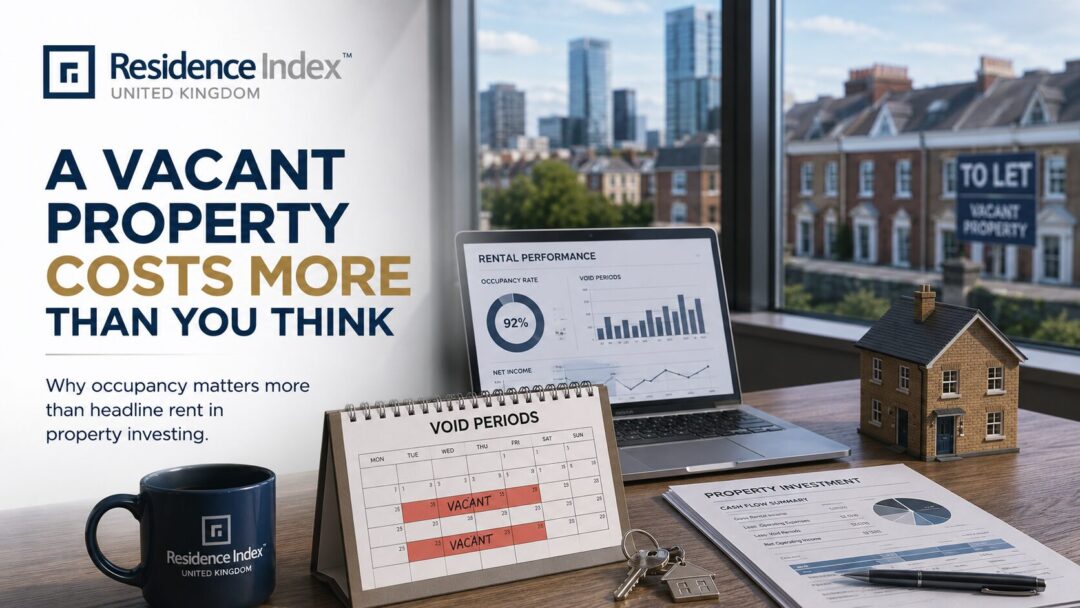
The Hidden Cost Nobody Talks About in Property Investing: Why Occupancy Beats Headline Rent
Many property investors spend countless hours comparing rental yields, purchase prices and projected capital growth.
But one of the biggest costs rarely appears in the sales brochure.
A vacant property.
Even a single empty month can quietly erode your annual returns. Add reletting fees, repairs, cleaning costs and lost rental income, and the impact becomes far greater than many investors expect.
The most successful investors don’t simply chase the highest rent.
They focus on keeping great tenants for longer.
The True Cost of a Void Period
When a property stands empty, the costs continue.
Mortgage payments don’t stop.
Service charges still need paying.
Insurance remains due.
Utilities may still need covering.
Meanwhile, there is no rental income coming in.
One vacant month represents an immediate loss of around 8% of annual rental income before any additional expenses are considered. That can quickly wipe out much of an investor’s yearly profit, particularly where financing costs are higher.
It’s More Than Just Lost Rent
Tenant turnover creates a chain of additional costs that many first-time investors underestimate.
These often include:
- Professional cleaning
- Redecoration and repairs
- Safety inspections
- Letting agent fees
- Marketing costs
- Inventory updates
- Referencing new tenants
- Administration and compliance work
Individually these expenses may seem manageable.
Together they can significantly reduce your net return.
This is why experienced investors always calculate net income rather than relying solely on gross yield.
You can explore more investment strategies in our Property Blog:
https://www.residenceindexuk.com/blog/
Headline Rent Doesn’t Tell the Full Story
Many investors naturally compare properties by asking one question:
“Which one generates the highest rent?”
A better question is:
“Which one will remain occupied most consistently?”
A property earning slightly less rent but occupied throughout the year will often outperform a property that experiences frequent vacancies.
Reliable occupancy creates:
- Consistent cash flow
- Lower management costs
- Fewer maintenance issues
- Better long-term financial planning
Predictability is often more valuable than chasing the highest possible monthly rent.
Why Some Properties Stay Occupied
Tenants today have more choice than ever.
They increasingly prioritise:
- Excellent locations
- Strong transport links
- High-quality amenities
- Modern finishes
- Professional property management
- Responsive maintenance
Properties that meet these expectations are typically easier to let and experience lower tenant turnover.
This is one reason professionally managed Build-to-Rent developments continue to attract both tenants and investors.
Browse our carefully selected developments:
https://www.residenceindexuk.com/residence-index-uk-properties/
Buying What Tenants Actually Want
Successful investing isn’t simply about buying property.
It’s about buying property that tenants actively choose.
Cities such as London, Manchester and Birmingham continue attracting strong demand because they benefit from:
- Growing employment
- Major regeneration projects
- Expanding populations
- Excellent universities
- International investment
- Ongoing housing shortages
Strong demand helps reduce vacancy risk while supporting more stable rental income over the long term. Recent research also shows tenant demand remains robust across much of the UK despite changing market conditions.
The Rent Reform Effect
As rental regulations continue evolving, operational efficiency becomes increasingly important.
Managing frequent tenant turnover requires more administration, compliance and communication than ever before.
Investments that encourage longer tenancies and stable occupancy are becoming even more attractive in today’s market.
Professional management can help minimise operational friction while improving the overall tenant experience.
Focus on the Right Metric
It’s easy to become distracted by impressive rental yield figures.
However, experienced investors understand that sustainable returns come from combining:
- Strong occupancy
- Quality tenants
- Professional management
- Prime locations
- Long-term demand
The best-performing investment isn’t always the one advertising the highest rent.
It’s often the one that rarely sits empty.
Final Thoughts
Vacancy is one of the most overlooked costs in property investing.
While investors cannot eliminate every risk, they can significantly reduce void periods by choosing high-demand locations, well-managed developments and homes that tenants genuinely want to live in.
Over time, consistent occupancy often delivers stronger overall returns than simply chasing the highest advertised rent.
If you’re building a long-term property portfolio, don’t just ask how much rent a property can achieve.
Ask how often it stays occupied.
Related Articles
You may also find these helpful:
- https://www.residenceindexuk.com/blog/
- https://www.residenceindexuk.com/residence-index-uk-properties/
Recommended External References
● National Residential Landlords Association (NRLA) – Landlord Market Research
https://www.nrla.org.uk/
● Savills – UK Residential Research
https://www.savills.co.uk/research/
● Office for National Statistics (ONS) – Housing and Population Data
https://www.ons.gov.uk/
● Rightmove – Rental Market Reports
https://www.rightmove.co.uk/news/rental-trends/
● Bank of England – Interest Rates and Housing Market Data
https://www.bankofengland.co.uk/monetary-policy/the-interest-rate