
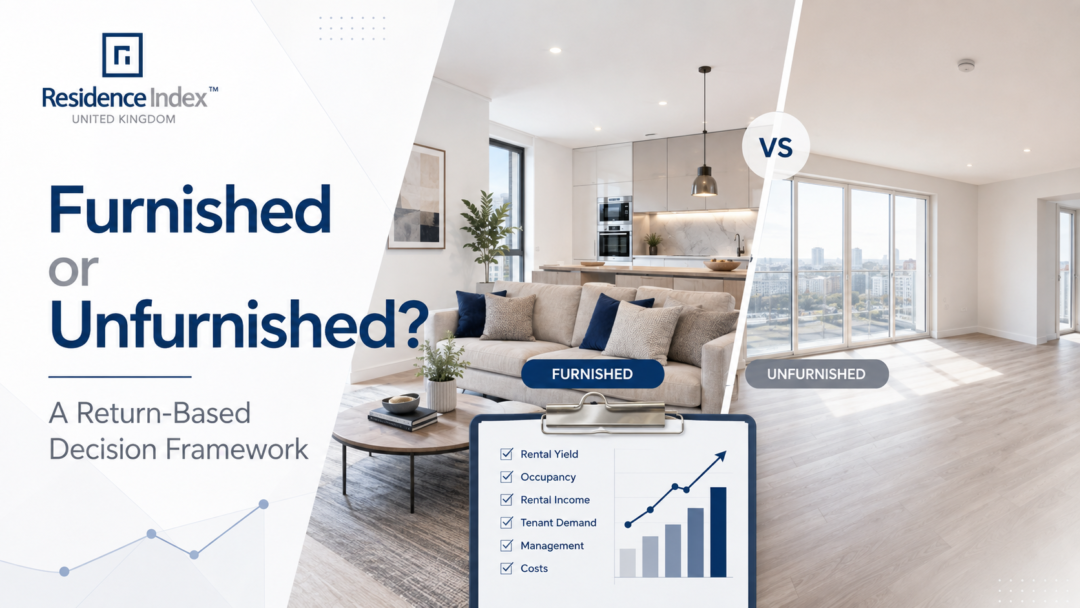
Furnished or Unfurnished? A Return-Based Decision Framework
Furnished or Unfurnished? A Return-Based Decision Framework
Should an investment property be furnished or unfurnished?
It sounds like a simple operational decision.
Buy furniture, or do not.
However, for an investor, the decision should not be based on personal taste. Choosing between a furnished or unfurnished property should come down to which option produces the stronger risk-adjusted return for that particular property, location and tenant market.
Furniture can potentially support a higher rent, make a property easier for certain tenants to move into and strengthen its position in competitive city-centre markets.
It can also create additional upfront expenditure, replacement costs, inventory management and maintenance.
Unfurnished property may cost less to prepare and can appeal to tenants wanting to establish a longer-term home. But removing furniture is not automatically more profitable either.
The correct question is therefore not:
“Would this flat look better furnished?”
It is:
“Does furnishing this property improve the investment return enough to justify the additional cost and risk?”
That requires a framework.
Start With the Tenant, Not the Furniture
Before comparing furniture packages, identify the tenant the property is most likely to attract.
A furnished apartment can make particular sense where the likely tenant values convenience and mobility.
That could include:
- young professionals;
- corporate tenants;
- international tenants;
- graduates relocating for work;
- tenants moving between cities;
- people expecting to stay for a relatively limited period.
An unfurnished property may appeal more strongly to tenants who already own furniture and expect to establish a longer-term home.
Families, couples moving from another rented property and tenants seeking greater control over their living space may fall into this category.
Neither tenant profile is automatically better.
The investment question is which profile has the deepest and most resilient demand in the property’s immediate market.
The English Housing Survey found that private renters commonly remain in their homes because they like the local area and because the home meets their needs. That is a useful reminder that furniture is only one component of the overall rental proposition. English Housing Survey rented sectors data
Location, layout, condition, management and affordability can matter just as much.
Step 1: Measure the Real Furnished Rent Premium
The first calculation is straightforward.
How much additional rent can the property realistically achieve when furnished?
Do not use a developer projection or an assumption such as:
“Furnished apartments normally rent for 10% more.”
There is no universal premium.
Instead, compare genuinely similar local properties.
Look for:
- the same bedroom count;
- similar internal floor area;
- comparable buildings;
- similar condition and specification;
- similar floors and views where relevant;
- similar amenities;
- the same immediate neighbourhood.
Then separate furnished and unfurnished evidence.
For example:
Unfurnished achievable rent: £1,500 per month
Furnished achievable rent: £1,625 per month
Potential premium: £125 per month
Annual premium: £1,500
The £1,500 figure is the starting point.
It is not the profit.
As discussed in our guide to tracking rent per square foot, investors should compare rental performance against the actual asset being purchased rather than relying solely on headline rent. Why Investors Should Track Rent per Square Foot.
Step 2: Calculate the Initial Furnishing Cost
Next, calculate what it costs to produce the additional rent.
A furnishing package might include:
- sofa;
- beds and mattresses;
- dining table and chairs;
- bedside furniture;
- wardrobes where not built in;
- lamps;
- curtains or blinds;
- kitchen equipment;
- television;
- occasional furniture;
- delivery and installation.
Suppose furnishing the apartment costs £6,000.
If the property earns an additional £1,500 a year because it is furnished, the simple gross payback period is:
£6,000 ÷ £1,500 = four years
That sounds reasonable.
But the analysis is still incomplete.
Furniture does not last forever.
Step 3: Add Replacement and Damage Costs
A furnished property creates depreciating items inside the investment.
Sofas wear.
Mattresses require replacement.
Dining chairs break.
Furniture is marked during moves.
Small appliances fail.
Tenants may damage items beyond fair wear and tear.
Investors should therefore create a realistic annual furniture reserve.
Imagine a £6,000 package expected to require substantial replacement over six years.
A simple reserve could be approximately:
£6,000 ÷ 6 = £1,000 per year
Now reconsider the £1,500 annual furnished rent premium.
After allowing £1,000 for furniture replacement, only £500 of the premium remains before considering any other differences in management, voids or maintenance.
This is why furnished versus unfurnished should be a return calculation rather than a rent comparison.
Tax treatment should also be understood correctly. HMRC’s Replacement of Domestic Items Relief broadly concerns qualifying replacement expenditure rather than the original purchase of the items. Investors should take tax advice based on their own circumstances rather than assuming the complete furnishing bill is immediately deductible. HMRC Replacement of Domestic Items Relief guidance
Step 4: Model the Effect on Void Periods
Furniture may affect how quickly a property lets.
That can be more important than a modest rental premium.
Imagine an unfurnished property achieves £1,500 per month but typically loses four additional weeks between tenants.
A furnished version achieves £1,600 and attracts tenants more quickly.
The difference is no longer simply £100 per month.
The investor should compare annual collected rent.
For example:
Unfurnished
£1,500 × 11 months occupied = £16,500
Furnished
£1,600 × 11.5 months occupied = £18,400
The effective annual difference becomes £1,900.
But the opposite can also occur.
If most tenants in a suburban family market already own furniture, furnishing the property could narrow the tenant pool and lengthen the void.
The decision therefore depends on observed tenant behaviour in the micro-market.
Step 5: Consider Tenant Turnover
Higher rent is not always better if achieving it means replacing tenants more frequently.
Suppose a furnished city-centre flat attracts tenants who stay for 12 to 18 months.
An unfurnished alternative attracts tenants staying three or four years.
The unfurnished property may benefit from:
- fewer letting fees;
- fewer inventories;
- fewer check-outs;
- reduced redecorating;
- less furniture damage;
- fewer vacant periods;
- lower management intensity.
A £100 monthly furnished premium can disappear quickly if the additional tenant turnover creates £1,500 or £2,000 of extra costs every few years.
This connects with a broader principle in property investment: gross yield is not the same as investor return.
Our guide to why yield is often misunderstood explains why costs, risk and sustainability must sit alongside the headline percentage. Why Yield Is the Most Misunderstood Metric in UK Property Investment
Step 6: Include Management Complexity
Furniture creates another operational layer.
Someone must manage:
- inventories;
- replacement items;
- damaged furniture;
- delivery access;
- removal of old items;
- disputes over condition;
- contractor coordination.
For a landlord managing personally, this may represent additional time.
For a professionally managed property, it may create additional charges.
Investors should therefore examine the management agreement rather than assuming the headline management percentage covers everything.
As explained in our analysis of property management agreements, repair authorisation, contractor costs, re-letting fees and other operational provisions can quietly influence net returns. What a Management Agreement Can Quietly Do to Your Returns
Step 7: Do Not Ignore Furniture Safety
Where landlords provide furniture and electrical items, they also take responsibility for ensuring supplied items meet applicable safety requirements.
GOV.UK guidance states that landlords must keep rented properties safe and ensure electrical equipment they provide is safely installed and maintained. Furnishings supplied by landlords must also meet applicable fire-safety requirements. GOV.UK landlord safety responsibilities
Legal requirements differ across the UK, so investors should check the rules applying to the property’s jurisdiction and obtain professional advice where necessary.
This is not an argument against furnishing.
It is simply another cost and responsibility that should be included in the decision.
Step 8: Calculate Net Furnishing Return
A useful metric is the return generated specifically by furnishing the property.
Consider this hypothetical example.
Furnished Option
Additional annual rent: £1,800
Estimated annual reduction in void losses: £400
Total estimated annual benefit: £2,200
Less:
Furniture replacement reserve: £800
Additional maintenance and inventory costs: £250
Estimated additional net benefit: £1,150
Initial furnishing cost: £6,000
That means the furnishing decision produces an approximate:
£1,150 ÷ £6,000 = 19.2% annual return on the furnishing expenditure
That could be attractive.
Now change one assumption.
Suppose the furnished premium is only £60 per month rather than £150.
Annual premium becomes £720.
After replacement and management costs, the incremental return could become negligible or negative.
This illustrates why furnishing decisions should be underwritten rather than assumed.
Step 9: Stress-Test the Furniture Premium
Do not calculate only the optimistic case.
Use at least three scenarios.
Strong Case
The full projected rent premium is achieved and occupancy improves.
Base Case
A smaller rent premium is achieved with similar occupancy.
Weak Case
There is no meaningful rent premium and furniture still needs replacing.
Then ask:
Does furnishing still make sense?
If the investment works only when every optimistic assumption is achieved, the decision may be fragile.
The same principle applies across property underwriting.
Furnishing Matters More in Some Markets Than Others
Location and tenant profile can change the calculation dramatically.
In a city-centre professional market such as Manchester, Birmingham, Liverpool or parts of London, a high-quality furnished apartment may offer genuine convenience to tenants relocating for employment.
However, that does not mean every apartment in those cities should be furnished.
The micro-location and unit type still matter.
Our analysis of Birmingham’s premium rental market demonstrates why above-average rents must be justified by a genuinely stronger residential proposition rather than simply labelling an apartment “premium”. Birmingham Premium Rental Market analysis
The latest ONS figures underline how different rental markets can be. Average UK private rent reached £1,393 per month in July 2026, while London averaged £2,317 and the North East £783. Local conditions matter far more than a national rule about whether furnished property performs better. ONS Private Rent and House Prices: August 2026
Completed and Tenanted Properties Provide Useful Evidence
One way to reduce uncertainty is to examine properties that are already operating.
A completed and tenanted apartment can provide evidence of:
- the actual furniture specification;
- current rent;
- tenant profile;
- management arrangements;
- occupancy;
- condition after occupation.
That does not remove risk, but it can replace some assumptions with observable information.
Our guide to completed and tenanted assets explains why this visibility can be particularly useful for time-poor and overseas investors. Completed and Tenanted Assets for Time-Poor Investors
A Simple Furnished or Unfurnished Decision Framework
Before choosing, put both options into the same spreadsheet.
Compare:
Factor | Furnished | Unfurnished |
Achievable monthly rent | £ | £ |
Expected occupancy | % | % |
Annual collected rent | £ | £ |
Initial setup cost | £ | £ |
Annual replacement reserve | £ | £ |
Management costs | £ | £ |
Expected tenant stay | Months | Months |
Re-letting costs | £ | £ |
Maintenance allowance | £ | £ |
Estimated annual net income | £ | £ |
Then ask five questions:
- Is the furnished rent premium supported by real comparables?
- Does furnishing reduce or increase expected voids?
- How often will the furniture realistically need replacing?
- Which option matches the deepest tenant demand?
- Which produces the better net return after all costs?
That is the decision.
Not which property photographs better.
Not which option feels more premium.
Not which package the sales brochure recommends.
When Furnished Can Make Sense
A furnished strategy can be attractive where:
- tenants value immediate move-in convenience;
- local furnished comparables demonstrate a sustainable rent premium;
- corporate or relocating professionals form an important tenant group;
- shorter letting periods are normal;
- quality furniture improves the property’s competitive position;
- the premium comfortably exceeds replacement and management costs.
When Unfurnished Can Make Sense
An unfurnished strategy can be stronger where:
- the tenant market expects longer stays;
- tenants commonly own their own furniture;
- the furnished premium is small;
- furnishing would restrict the tenant pool;
- turnover costs are more important than maximising monthly rent;
- the investor wants lower operational complexity.
The Better Investment Question
“Furnished or unfurnished?” is not really a furnishing question.
It is a capital-allocation question.
If spending £6,000 on furniture reliably generates £1,500 of additional net income every year, that expenditure may be highly productive.
If it generates only £400 while creating more maintenance, replacements and turnover, the capital may be better used elsewhere.
The strongest decision is therefore based on:
tenant demand + collected rent + void risk + furnishing cost + replacement cost + management + holding period.
Only after those factors have been compared does the furniture itself matter.
Investors can explore the current Residence Index UK property portfolio, including opportunities across Manchester, Birmingham, Liverpool and London, and assess each property according to its likely tenant market and complete return profile. Explore Residence Index UK Properties
For further investment analysis, market commentary and due-diligence frameworks, visit the Residence Index UK property investment blog. Residence Index UK Blog
This article is for general information only and does not constitute financial, tax or legal advice. Rental demand, regulations and tax treatment vary according to location and individual circumstances.