
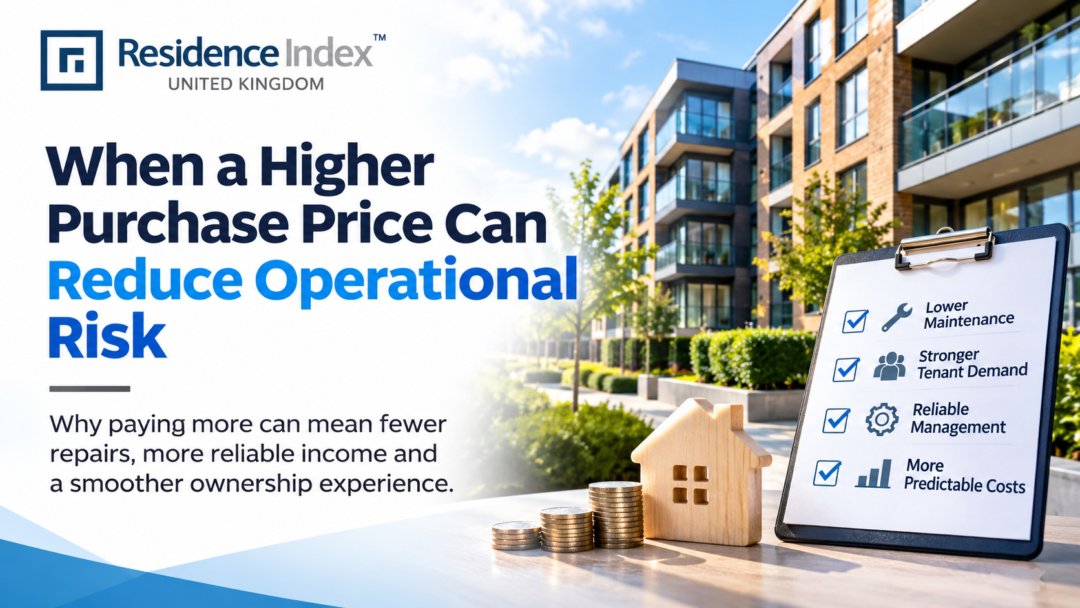
Property Operational Risk: When Paying More Makes Sense
When a Higher Purchase Price Can Reduce Operational Risk
A lower purchase price does not always mean a lower-risk property investment. Sometimes, paying more for the right property can reduce maintenance uncertainty, tenant turnover and unexpected costs.
For UK property investors, particularly overseas buyers, understanding property operational risk is just as important as calculating rental yield.
The cheapest property on the shortlist may not be the easiest to own.
Why Purchase Price Is Only Part of the Equation
Investors naturally compare asking prices, rental estimates and projected yields.
However, these figures do not reveal the full cost of ownership.
Two properties generating similar rental income can produce very different investment experiences.
One might require frequent repairs, additional management and regular tenant replacement.
The other might offer more reliable building systems, stronger tenant appeal and fewer operational interruptions.
The difference becomes clearer after several years of ownership.
This is why investors should look beyond the initial purchase price and consider the property’s long-term operating requirements.
1. Better Building Quality Can Reduce Maintenance Uncertainty
A higher-priced property may offer better construction quality, newer installations and more dependable building infrastructure.
Potential advantages include:
- Modern heating and electrical systems
- Better insulation and energy efficiency
- More durable fixtures and finishes
- Fewer immediate refurbishment requirements
- Appropriate new-build warranties or building guarantees
These features can reduce some maintenance risks, although they do not eliminate unexpected repairs.
Newer buildings can also experience defects, while premium developments may have complex communal systems.
Investors should still investigate construction quality, warranties, management arrangements and maintenance responsibilities.
The goal is not to avoid maintenance entirely. It is to make future costs more predictable.
2. Stronger Tenant Appeal May Reduce Void Risk
A property that attracts consistent tenant interest can help reduce the uncertainty associated with vacant periods.
Location, transport access, layout and everyday convenience all influence rental appeal.
A well-connected apartment near employment centres, universities and amenities may attract a wider range of prospective tenants.
However, a premium purchase price is only justified when the rental market supports it.
Investors should compare actual rental evidence, competing supply and local tenant demand.
Explore the wider selection of UK investment properties to understand how location and property specifications differ.
3. Lower Tenant Turnover Can Reduce Operating Costs
Tenant turnover can create costs beyond the loss of rental income.
These may include cleaning, minor repairs, marketing, referencing and letting fees.
A property that tenants are comfortable remaining in may reduce the frequency of these expenses.
Features supporting longer tenancies can include:
- Practical layouts and storage
- Reliable heating and broadband connectivity
- Convenient transport links
- Good building management
- Access to useful local amenities
Premium finishes alone do not guarantee tenant retention.
The property must meet the practical needs of its target market.
4. Predictable Management Can Be Worth Paying For
Operational risk also includes the time and effort required to manage a property.
For overseas investors, this can be especially important.
A lower-priced property requiring frequent intervention may become difficult to manage remotely.
A professionally managed development may provide clearer maintenance procedures, established building services and more structured communication.
However, management quality should be verified rather than assumed.
Investors should examine service standards, management fees, maintenance records and responsibilities before committing.
For additional guidance, visit the Residence Index UK property investment blog.
5. A Higher Price Can Still Produce a Better Risk-Adjusted Outcome
Consider two hypothetical properties.
Property A — Lower Purchase Price
Purchase price: £180,000
Annual rental income: £13,200
Gross rental yield: 7.33%
Annual operating costs: £4,200
Net operating income: £9,000
Net operating yield: 5.00%
Property B — Higher Purchase Price
Purchase price: £220,000
Annual rental income: £15,000
Gross rental yield: 6.82%
Annual operating costs: £3,000
Net operating income: £12,000
Net operating yield: 5.45%
Property A appears more attractive when comparing gross yields.
However, Property B produces higher net operating income and a slightly stronger net operating yield under these assumptions.
The higher purchase price has not automatically made Property B riskier.
Its assumed operating efficiency helps offset the additional investment.
These figures are illustrative, not forecasts. Operating costs include assumed maintenance, management, void allowances and other recurring expenses, but exclude financing, acquisition costs and tax. Actual outcomes could be very different.
6. When Paying More Does Not Reduce Risk
A premium property can still become a poor investment.
Higher purchase prices may introduce different risks, including:
- Excessive service charges
- Limited tenant demand at premium rents
- Expensive communal facilities
- Overdependence on capital appreciation
- Reduced resale liquidity
- Greater exposure to borrowing costs
A development with extensive amenities may look attractive but require substantial ongoing expenditure.
Investors should therefore examine service charge budgets, reserve funds, lease obligations and potential major works.
The Leasehold Advisory Service provides useful information about leasehold ownership and service charges in England and Wales.
7. How to Assess Operational Risk Before Buying
Rather than comparing properties solely by purchase price, investors should examine five areas.
Maintenance Exposure
What repairs or replacements are likely over the next five to ten years?
Tenant Demand
Is there evidence of sustainable rental demand at the proposed rent?
Management Quality
Who handles maintenance, tenant communication and building operations?
Recurring Costs
Are service charges, insurance and management fees realistic and sustainable?
Exit Flexibility
Would the property appeal to a sufficiently broad range of future buyers?
For market context, the Office for National Statistics publishes UK housing and private rental price information.
Local comparables and property-specific due diligence remain essential.
The Bottom Line
A higher purchase price can reduce operational risk when the additional investment delivers genuine improvements in building quality, tenant appeal, management reliability or cost predictability.
But paying more is not automatically safer.
The objective is to identify properties where the premium is supported by measurable advantages.
Good property investing is not simply about buying cheaply. It is about owning sustainably.
Explore more UK property investment insights at Residence Index UK and browse available property opportunities.