
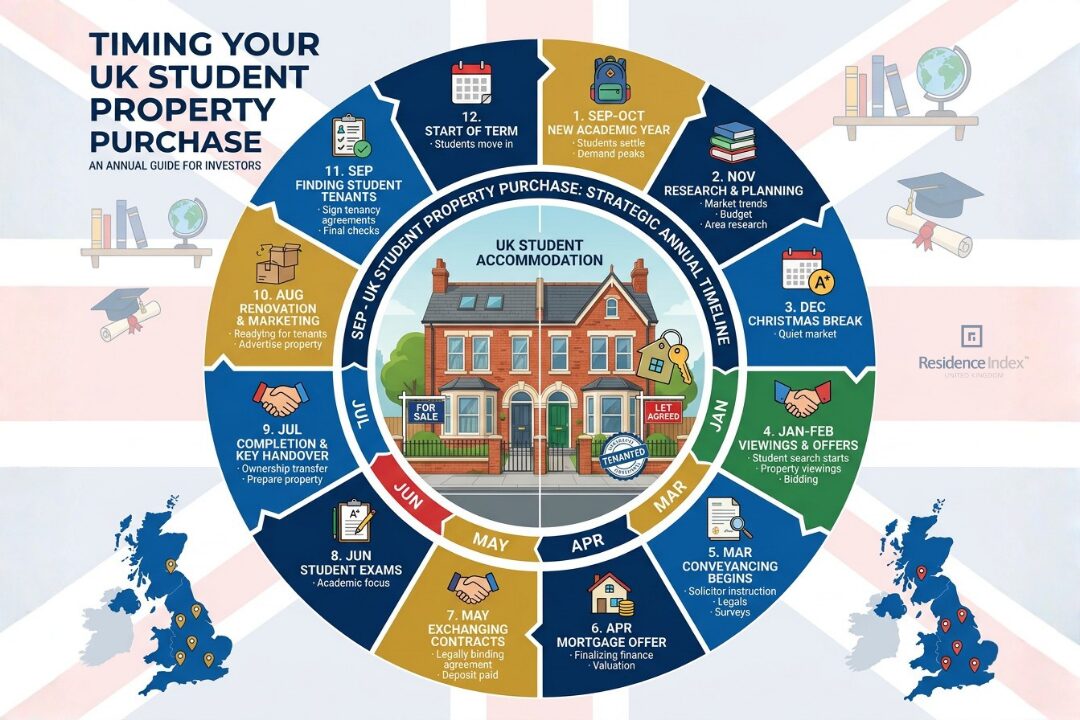
How to Time a Student Let Purchase — Without Missing the Cycle
Why Timing Matters More Than Price in Student Property
In most areas of property investment, timing is helpful.
In student property, it is decisive.
Miss the right window, and you don’t just lose a few weeks of rent — you risk losing an entire academic year of income. That reality is often underestimated, particularly by investors entering the sector for the first time.
Every year, we see the same pattern: purchases completed too late, refurbishments running over, licensing delayed — and ultimately, properties missing the peak letting window.
The issue is rarely the deal itself.
It is the timing of execution.
📅 Understanding the Student Letting Cycle
Unlike standard buy-to-let, student demand follows a predictable annual rhythm.
The strongest properties — well-located, well-presented, and appropriately priced — are often secured early in the cycle, sometimes as early as November or December for the following academic year.
By February through April, the market is in full flow. This is when the majority of students finalise accommodation, particularly in established university cities.
By late spring and early summer, demand begins to thin. Tenants are still present, but the quality and certainty of demand tends to decline. By August, the market is largely in clearance mode.
The key implication is simple:
If your property is not ready by spring, you are already behind the cycle.
⏳ The Importance of Working Backwards
The most reliable way to approach student investment is not to think about when you want to buy — but when you need the property to be ready.
If your objective is to secure tenants for the September 2026 intake, the timeline should be considered in reverse.
Allowing for conveyancing, potential refurbishment, and any licensing requirements, most investors should be targeting completion no later than early Q2. Marketing activity should ideally begin in April or May, while demand is still strong and tenants have choice.
This creates a narrow but manageable window.
The challenge is that any delay — in legals, works, or compliance — compresses that window rapidly.
⚠️ What Happens When the Timing Slips
When a purchase completes in late Q2 or early Q3, the dynamics change quickly.
The tenant pool becomes more limited. Decision-making becomes more price-sensitive. Letting periods extend. In some cases, landlords are forced to accept partial occupancy or discounted rents simply to avoid a full void.
In the worst-case scenario, the property misses the academic cycle entirely.
At that point, the issue is no longer yield optimisation — it is income recovery.
A missed cycle can mean 9–12 months of underperformance, which is difficult to recover even in a strong market.
🧾 Licensing and Compliance: The Hidden Variable
One of the most common causes of delay is not the purchase itself, but what comes after.
In many areas, student properties fall under HMO licensing regimes. Depending on the local authority, this may involve:
- Application lead times
- Property inspections
- Fire safety upgrades
- Layout or amenity requirements
In Article 4 areas, planning constraints may also apply.
These processes are not always predictable, and delays are common. Investors who fail to factor this into their timeline often find themselves ready operationally — but unable to let legally.
In 2026, with compliance standards tightening, this risk is increasing rather than decreasing.
🏙️ Not All Locations Behave the Same
Timing pressure is most acute in strong university markets where demand is well established and competition for quality stock is high.
Cities such as Leeds, Manchester, Nottingham and Sheffield tend to follow the cycle closely, with early demand and relatively disciplined letting patterns.
In secondary markets, or where supply has increased significantly, the cycle may be more forgiving — but this often comes with weaker pricing power and less predictable occupancy.
As with most property decisions, location determines not just value, but timing sensitivity.
🏢 PBSA vs Traditional HMOs
It is also worth distinguishing between different student investment models.
Purpose-built student accommodation (PBSA) tends to operate on a more structured basis, with centralised management and defined letting cycles. This can reduce operational risk and remove some of the timing pressure from individual investors.
By contrast, traditional HMOs offer more control and, in many cases, stronger yield potential — but they require more active management and far greater precision in execution.
Timing matters in both models, but the consequences of getting it wrong are typically more severe in HMOs.
🧠 RIUK View
In 2026, student property remains a compelling asset class — but it is not forgiving.
Success is less about finding the perfect deal, and more about aligning acquisition, compliance, and marketing with the cycle.
We approach all student acquisitions by working backwards from the September intake, ensuring that:
- Properties are acquired early enough
- Refurbishment and licensing are accounted for upfront
- Marketing begins while demand is still strong
This discipline is what protects income — not the purchase price alone.
🎯 Final Thought
Student property does not reward delay.
It rewards preparation.
The key question is not: “Is this a good investment?”
It is: “Will this property be ready in time to meet demand?”
Because if the answer is no, the strength of the deal becomes largely irrelevant.