
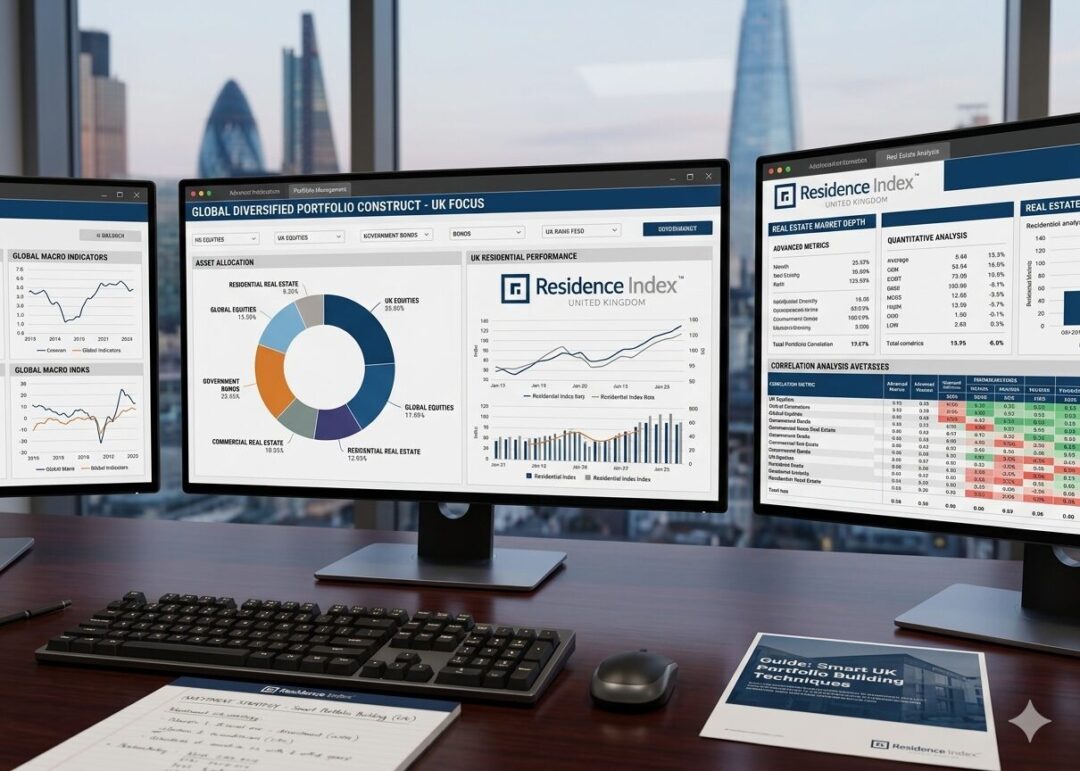
How Smart Investors Actually Build Property Portfolios in the UK
Most people think successful property investors simply buy more properties.
But that is rarely how strong portfolios are actually built.
In reality, smart investors focus less on collecting assets — and more on building systems.
Because in 2026, portfolio performance is no longer driven by quantity alone.
It is driven by:
- Stability
- Scalability
- Tenant demand
- Operational efficiency
- Long-term positioning
The Biggest Misunderstanding About Property Portfolios
Many investors assume portfolio growth means:
Buy property → refinance → repeat
While leverage remains important, experienced investors understand that growth without structure creates fragility.
A portfolio with:
- High void exposure
- Weak tenant quality
- Poor management systems
- Heavy maintenance demands
Can quickly become difficult to operate profitably.
That is why smarter investors increasingly focus on sustainability — not just expansion.
Smart Investors Think in Systems
Professional investors rarely analyse properties individually.
They analyse how assets work together.
For example:
- Are the properties in strong rental corridors?
- Is tenant demand consistent?
- Are management processes scalable?
- Is cash flow resilient during market shifts?
According to the Bank of England, higher borrowing costs have changed how investors assess portfolio risk.
As financing becomes more expensive, inefficient portfolios become more exposed.
That is why operational efficiency matters more than ever.
Strong Portfolios Are Built Around Demand
One of the clearest patterns among experienced investors is this:
They prioritise demand before yield.
Institutional research from Savills and JLL consistently highlights cities with:
- Population growth
- Employment expansion
- Graduate retention
- Infrastructure investment
Cities such as Manchester and Birmingham continue attracting long-term investor attention because demand fundamentals remain strong.
This creates:
- Better occupancy stability
- Longer tenant retention
- Stronger liquidity at exit
And over time, those factors compound.
Smart Investors Avoid “Yield Traps”
A high headline yield can look attractive initially.
But experienced investors understand that yield without stability often creates problems.
We explored this further in:
👉 /cheap-rent-wrong-tenants-uk
Because lower-quality stock often brings:
- Higher turnover
- More voids
- Greater management intensity
- Increased maintenance costs
Smart investors instead ask:
“Will tenants consistently choose this asset?”
That question matters more than the headline percentage.
Portfolio Building Is About Repeatability
Strong investors build portfolios that can scale without creating operational chaos.
That often means prioritising:
- Professionally managed assets
- Strong tenant demographics
- High-demand locations
- Predictable maintenance structures
As we discussed in:
👉 /fully-managed-property-investment-2026
Many investors are increasingly prioritising lower-friction ownership models.
Not because they avoid risk.
But because scalable systems improve long-term sustainability.
The Role of Risk Management
Smart investors also understand that every property carries risk.
The goal is not eliminating risk entirely.
It is managing risk intelligently.
This includes evaluating:
- Interest rate exposure
- Local oversupply risk
- Tenant demand trends
- Regulatory changes
- Exit liquidity
According to the Office for National Statistics, rental demand remains structurally strong across many UK urban markets — but not all locations perform equally.
This is why strategic selection matters.
What Smart Investors Actually Prioritise
The strongest portfolios are often built around:
1. Demand-Led Locations
Areas where tenants consistently want to live.
2. Occupancy Stability
Reliable income matters more than theoretical maximum rent.
3. Scalable Operations
Efficient management structures reduce friction.
4. Long-Term Holding Power
Assets that remain attractive over multiple market cycles.
5. Predictable Cash Flow
Especially important in higher-rate environments.
Final Thought
Smart investors do not build portfolios by chasing random deals.
They build portfolios by creating repeatable systems around:
- Demand
- Stability
- Scalability
- Operational efficiency
In 2026, successful property investing is becoming less about speculation — and more about disciplined portfolio construction.
Because the best portfolios are not simply bigger.
They are stronger.