
Developer Due Diligence: 5 Documents Property Investors Rarely Request
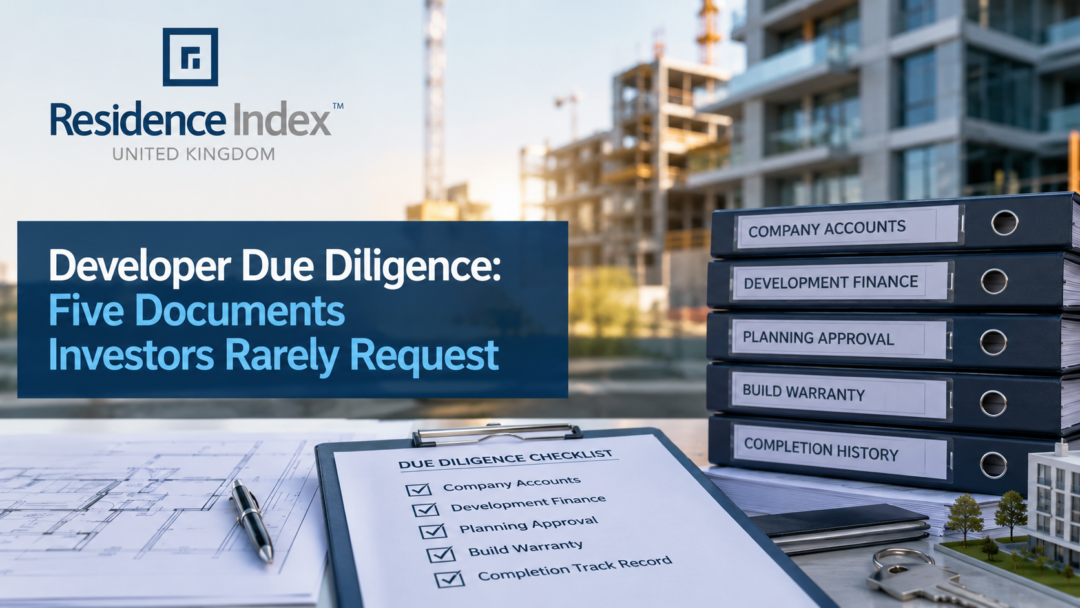
Developer Due Diligence: Five Documents Investors Rarely Request
Most investors perform some form of due diligence before buying a new-build or off-plan property.
They check the location.
They compare the price.
They look at the developer’s website.
They review the brochure, projected rent and expected completion date.
But that is not the same as developer due diligence.
The documents that can reveal more about a development are often the ones that never appear in the sales presentation.
A glossy track record tells you what a developer wants you to see. Proper documentation can help you understand how the development is structured, financed, approved and protected.
That distinction becomes particularly important with off-plan property, where an investor may exchange contracts long before receiving the finished asset.
Here are five documents — or document sets — worth discussing with your solicitor or adviser before committing capital.
1. The Developer’s Latest Filed Accounts
Many buyers research the development but spend surprisingly little time researching the company delivering it.
Start with the legal entity named in your purchase documentation.
The UK’s Companies House register allows investors to inspect company information, including accounts, directors and filing history.
However, do not stop at the trading name.
A development may involve:
- A parent company
- A special-purpose vehicle (SPV)
- A separate landowner
- A development company
- Different contracting and selling entities
The important question is not simply:
“Is the developer a large company?”
It is:
“Which legal entity am I actually contracting with, and what stands behind its obligations?”
Ask your solicitor or accountant whether the latest accounts reveal anything that warrants further investigation.
Investor takeaway
A recognisable brand does not automatically mean every obligation is guaranteed by the wider group.
Understand the entity behind the contract.
2. Development Finance and Charge Information
This is one of the least glamorous parts of developer due diligence — and potentially one of the most important.
Investors should understand, as far as their professional advisers consider appropriate, how the scheme is being funded.
Questions can include:
- Is there senior development finance?
- Are charges registered against the development company?
- Who holds security over the site?
- What conditions apply before units can complete?
- How are buyer deposits handled?
- What happens to those deposits before completion?
Companies House records can provide information on registered charges, while your solicitor can investigate the legal structure surrounding the property.
This does not mean that debt is inherently problematic.
Property development normally requires substantial capital.
The objective is to understand the structure rather than assume that “fully funded” means risk-free.
Residence Index UK has previously discussed the importance of looking beyond marketing material when assessing developer red flags and green lights.
Investor takeaway
Do not simply ask whether a project is funded.
Ask how it is funded and what that structure could mean for purchasers.
3. The Planning Decision Notice and Outstanding Conditions
A brochure may say:
“Full planning permission secured.”
That statement alone does not tell you everything.
Planning approvals can contain numerous conditions governing matters such as:
- Materials
- Landscaping
- Access
- Drainage
- Environmental requirements
- Construction sequencing
- Highways works
- Affordable housing obligations
- Pre-occupation requirements
Some conditions may need to be discharged before specific stages of development can proceed.
Homes England’s own development-monitoring framework includes planning-condition tracking alongside cost, insurance, contracts, warranties and other project risks.
For investors, the lesson is straightforward:
Do not rely solely on a sentence in a brochure.
Ask your solicitor to review the relevant planning position and explain anything material to your purchase.
This principle is similar to assessing a regeneration story. As we explained in How to Separate a Real Growth Story From a Regeneration Sales Pitch, investors should distinguish evidence from narrative.
Investor takeaway
“Planning approved” should begin the conversation, not end it.
4. The Build Warranty Documentation
“We have a warranty.”
Good.
Which warranty?
That is the more useful question.
New-build warranties can provide important protection against certain defects, but investors should understand:
- Who provides the warranty?
- What exactly does it cover?
- When does cover begin?
- How long does it last?
- What exclusions apply?
- Is the provider acceptable to the intended mortgage lender?
- What happens if defects appear?
The Competition and Markets Authority’s housebuilding market study notes that new-build warranties are generally insurance products arranged by housebuilders for the benefit of purchasers and, where applicable, lenders.
NHBC documentation also demonstrates the level of technical information that may sit behind warranty applications on larger developments.
Do not treat the words “10-year warranty” as the complete due-diligence exercise.
Ask for the relevant documentation and have your solicitor explain the protection.
Investor takeaway
The existence of a warranty matters.
The provider, wording and scope matter more.
5. Evidence of the Developer’s Actual Completion Record
This is not one document in the conventional sense.
It is a file investors should build.
Ask for a schedule of previously completed developments showing:
- Development name
- Location
- Original expected completion
- Actual completion
- Number of units
- Warranty provider
- Current management arrangements where relevant
Then verify what you reasonably can.
Why?
Because “20 years of combined development experience” and “£500 million development pipeline” are marketing statements.
Neither tells you whether the company has repeatedly delivered developments similar to the one you are buying.
A developer may have experience building houses but limited experience delivering high-rise apartments.
Another may have completed hundreds of apartments but never a development with the amenities, construction complexity or scale now being marketed.
The most relevant track record is therefore not necessarily the biggest one.
It is the most comparable one.
Investor takeaway
Past delivery does not guarantee future delivery.
But a verifiable history of comparable completions gives investors far more information than a pipeline figure.
Why Investors Rarely Ask for These Documents
Because property is often sold visually.
Buyers are naturally drawn towards:
- CGI images
- Floor plans
- Rental forecasts
- Amenities
- Discounts
- Payment plans
- Expected capital growth
Those details matter.
But they mostly describe what the investment could become.
Developer due diligence examines what must happen before it gets there.
This is especially important when purchasing off-plan because the investor is not merely evaluating a finished apartment.
They are evaluating a future delivery obligation.
That requires a different mindset.
Due Diligence Should Change the Questions You Ask
A weak due-diligence process asks:
“Does this look like a good investment?”
A stronger process breaks that into separate questions:
Can the developer deliver it?
Is the project properly approved?
How is my money protected?
What contractual protections exist?
What evidence supports the projected completion?
What happens if the plan changes?
That approach fits a broader change in UK property investing.
As explored in The New Rules of Property Investing: What Actually Works in 2026?, today’s market increasingly rewards selectivity rather than simply acquiring whatever offers the most attractive headline numbers.
The same applies to off-plan pricing.
A credible developer can reduce one category of risk, but it does not automatically make a property good value. Investors should separately test whether an off-plan property may be overpriced.
Developer quality and investment quality are related — but they are not identical.
The Best Due Diligence Often Produces Boring Answers
This is worth remembering.
Good due diligence does not necessarily uncover a dramatic red flag.
Often, the best outcome is reassuringly uneventful:
The company structure makes sense.
The accounts raise no obvious concerns.
Planning is in place.
The warranty is credible.
The funding structure is understood.
Previous developments were delivered.
Your solicitor is comfortable with the contractual position.
That may sound boring.
For an investor committing hundreds of thousands of pounds, boring can be excellent.
Five Documents. One Bigger Question.
The purpose of developer due diligence is not to eliminate risk.
That is impossible.
It is to identify risks before you have committed enough money to regret discovering them.
Before reserving your next new-build or off-plan property, consider asking your solicitor or professional adviser to investigate:
- Latest company accounts and corporate structure
- Development finance and registered charges
- Planning decision and outstanding conditions
- Build warranty documentation
- Comparable development completion history
And remember: receiving a document is not the same as understanding it.
Professional legal, financial and technical advice remains essential.
Investors looking for professionally selected opportunities can also explore current Residence Index UK properties and compare developments with developer quality, tenant demand, location and long-term investment fundamentals in mind.
Final Thought
Property marketing naturally focuses on what a development will look like when everything goes right.
Due diligence asks what protects you if everything does not.
That may be the more valuable question.