
Capital Growth Property Investment: Avoid the Holding Trap
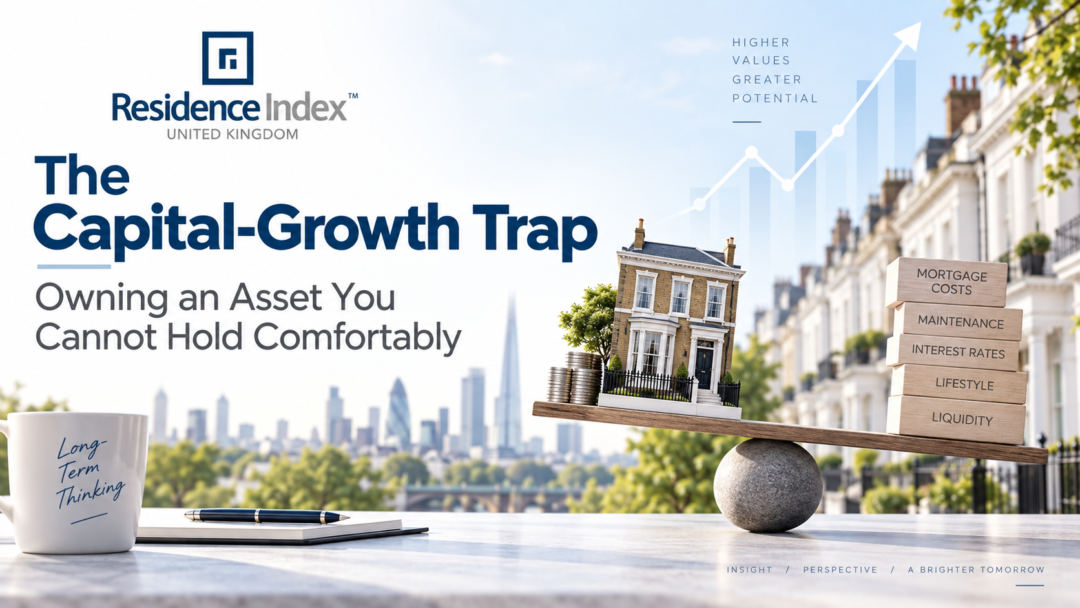
The Capital-Growth Trap: Owning an Asset You Cannot Hold Comfortably
Capital growth is one of the most attractive reasons to own property.
Buy a well-located asset. Hold it for years. Allow rents, wages, regeneration, infrastructure and constrained supply to support its value. Eventually, the property may be worth considerably more than you paid.
That is the theory.
But there is a problem investors sometimes overlook.
You have to be able to hold the property long enough for the theory to work.
An asset can have an excellent long-term story and still become a poor investment for a particular owner if the monthly cost of carrying it becomes uncomfortable.
That is the capital-growth trap.
The investor focuses so heavily on what the property might be worth in ten years that they underestimate what it could cost them to survive years one to nine.
Capital Growth Does Not Pay Next Month’s Bills
Suppose you purchase a property for £350,000.
Five years later, it is worth £420,000.
On paper, that is £70,000 of capital appreciation.
But during those five years you may also have faced:
- mortgage interest;
- service charges;
- management fees;
- insurance;
- maintenance;
- periods without rent;
- taxation;
- furniture replacement;
- compliance costs; and
- unexpected repairs.
The £70,000 gain does not arrive gradually in your bank account each month.
Unless you refinance or sell, much of that growth remains locked inside the property.
Your costs, however, are very real and very regular.
That difference matters.
A Good Asset Can Still Be the Wrong Asset for You
Property analysis often asks whether an investment is fundamentally attractive.
Investors examine:
- location;
- employment growth;
- tenant demand;
- regeneration;
- transport;
- supply;
- rental prospects; and
- future resale demand.
All of these matter.
But there is another question:
Can you personally hold this asset through an uncomfortable period?
That is not the same as asking whether the property is good.
A strong property may still be unsuitable if it places too much pressure on your finances.
This is why an investment should fit the portfolio rather than simply look impressive in isolation.
The principle is similar to the one explored in Your First Property Should Not Try to Do Everything: the correct investment depends on the job you need the asset to perform.
The Holding Period Is Part of the Investment
Capital-growth strategies are particularly dependent on time.
Imagine an investor expects a property to perform strongly over ten years.
That expectation might ultimately prove correct.
But what happens if the investor needs to sell in year three?
Perhaps:
- mortgage costs have risen;
- personal income has fallen;
- a business needs capital;
- family circumstances have changed;
- service charges have increased;
- several properties require repairs simultaneously; or
- refinancing is less attractive than expected.
The investor may be forced to sell at exactly the wrong point in the cycle.
Transaction costs also matter.
Buying and selling property can involve taxes, legal costs, finance fees, agency fees and other expenses.
A property does not need to fall significantly in value for an early exit to produce a disappointing result.
Sometimes the biggest risk is not choosing the wrong property.
It is losing control over when you sell it.
Growth on Paper Can Hide Cash-Flow Pressure
Consider a simplified illustration.
An investor owns a £350,000 property financed with a £245,000 interest-only mortgage.
Annual rent is:
£20,400
Assume normal operating and ownership costs excluding finance total:
£4,200
That leaves:
£16,200 before mortgage interest and tax
At an illustrative mortgage rate of 4.5%, annual interest would be approximately:
£11,025
Remaining cash flow:
£5,175
That is about:
£431 per month
Now model the same property at a 6% borrowing cost.
Annual mortgage interest becomes:
£14,700
Remaining cash flow falls to:
£1,500
Or approximately:
£125 per month
The property has not changed.
The tenant has not changed.
The rent has not changed.
The location has not changed.
Its long-term capital-growth prospects may be exactly the same.
But the owner’s ability to comfortably hold it has changed dramatically.
This is why a three-scenario property interest-rate stress test is relevant even for investors whose primary objective is capital appreciation rather than income.
Positive Cash Flow Is Not the Same as Comfortable Cash Flow
A spreadsheet showing £125 per month of surplus technically remains positive.
But is it enough?
One repair could consume an entire year’s surplus.
A short void could wipe it out.
An unexpected service-charge demand could require additional cash from the owner.
That is why the meaningful question is not simply:
“Does this property break even?”
Ask:
“How much margin do I need before I feel financially comfortable owning it?”
One investor may be perfectly comfortable contributing £500 per month towards an asset they strongly believe will appreciate.
Another may need property income to support household expenditure.
Neither approach is automatically wrong.
The mistake is buying the first strategy while having the finances of the second investor.
Your Personal Holding Capacity Matters
Investors frequently stress-test properties.
They should also stress-test themselves.
There are at least four important areas to consider.
1. Income Capacity
Could you still support the investment if your employment or business income fell temporarily?
The strongest position is rarely one where every property expense depends on uninterrupted personal income.
2. Cash Reserves
How many months of property expenses could you cover without rental income?
MoneyHelper’s buy-to-let mortgage guidance specifically advises landlords to plan for periods when no rent is coming in and to maintain savings that can cover significant repair bills.
A reserve is not simply idle capital.
It is part of what gives you the ability to remain invested when conditions become difficult.
3. Debt Exposure
How much of your portfolio depends on refinancing remaining inexpensive?
Leverage can amplify returns when asset values rise.
It can also reduce flexibility when finance becomes more expensive.
This is why investors should model several borrowing-cost assumptions rather than building a strategy around one mortgage quotation.
4. Personal Comfort
This is harder to place in a spreadsheet.
Would a £500 monthly shortfall bother you?
What about £1,000?
What if that continued for twelve months?
Investors often model what they can afford.
It can be equally useful to model what they are genuinely comfortable affording.
An investment that produces constant financial anxiety may eventually encourage poor decision-making even when the long-term fundamentals remain sound.
The Current Market Demonstrates Why Both Sides Matter
UK property provides a useful example.
According to the latest Office for National Statistics private rent and house price data available at the time of writing, average UK private rents increased by 3.7% in the twelve months to July 2026, while average UK house prices increased provisionally by 2.0% in the twelve months to June 2026.
Those figures help demonstrate why investors continue to consider both rental income and longer-term property values.
But financing still matters.
The Bank of England’s current Bank Rate stands at 3.75%, with the next Monetary Policy Committee decision scheduled for 17 September 2026.
The lesson is not that investors should attempt to predict exactly where interest rates or house prices go next.
It is that an investment needs enough resilience to survive several possible environments.
Do Not Confuse an Asset’s Growth Potential With Your Ability to Capture It
Imagine two investors buying identical flats.
They pay the same price.
They receive the same rent.
They have the same tenant.
They experience the same capital growth.
But Investor A has:
- six months of ownership costs in reserve;
- moderate leverage;
- stable personal income; and
- no reliance on rent for daily expenditure.
Investor B has:
- minimal cash reserves;
- higher leverage;
- several other heavily financed properties; and
- personal expenditure that already consumes most monthly income.
The asset is identical.
The investment risk is not.
Investor A may be able to wait through a weak property market.
Investor B may become a forced seller.
That difference can determine whether the eventual capital-growth story is ever realised.
Long-term investors may also benefit from separating sensible analysis from precise forecasting. Our guide to How to Judge a 10-Year Property Story explains why underlying demand drivers can be more useful than relying on an exact future selling-price prediction.
Management Costs Can Quietly Reduce Your Buffer
Holding comfort is not determined by mortgage payments alone.
For professionally managed apartments, investors also need to understand:
- letting management;
- service charges;
- maintenance;
- insurance;
- ground rent where applicable;
- tenant turnover costs;
- furniture replacement; and
- additional administration charges.
Our guide to What a Management Agreement Can Quietly Do to Your Returns explains why the headline management percentage may tell only part of the story.
A property producing an attractive gross yield can become substantially less comfortable once every ownership cost is included.
Good underwriting therefore focuses on the cash remaining after costs rather than the rent displayed in the brochure.
Capital Growth Should Create Options, Not Dependence
The most powerful capital-growth investments are often those investors do not need to sell.
If the asset performs strongly, they can choose to:
- continue holding;
- refinance;
- release equity;
- reduce debt;
- use rental income;
- sell and reinvest; or
- transfer wealth over the longer term, subject to appropriate professional advice.
That flexibility is valuable.
The opposite situation is dangerous.
If the investment plan requires the property to appreciate by a particular amount within a particular period simply to make the finances work, the investor has created dependence on something they cannot control.
Property markets do not operate according to individual investment timelines.
Five Questions Before Buying for Capital Growth
Before purchasing a growth-led property, ask:
Could I Hold It If Rates Were Higher?
Do not model only today’s mortgage.
Run several scenarios.
The Residence Index UK property interest-rate stress test provides a straightforward framework for testing expected, higher and stress-rate scenarios.
Could I Hold It Through a Six-Month Void?
This may be conservative for a strong rental market, but that is the purpose of stress testing.
You are testing resilience, not predicting vacancy.
Could I Handle an Unexpected £5,000 Cost?
The exact number will depend on the property.
The important issue is whether one unusual expense would destabilise your wider finances.
Would I Still Want the Investment If Prices Were Flat for Five Years?
This is one of the strongest tests of a supposedly growth-led investment.
If capital values remain unchanged for several years, do the rental income and underlying asset quality still justify owning it?
If I Needed to Sell Early, Who Would Buy It?
Think about the exit market before entering.
Potential future buyers might include:
- landlords;
- owner-occupiers;
- first-time buyers;
- downsizers;
- overseas investors; or
- institutional buyers.
A broad resale audience can provide valuable flexibility.
Do Not Swing Too Far Towards Cash Flow Either
Recognising the capital-growth trap does not mean investors should automatically choose the property producing the highest immediate yield.
High-yield assets can bring different risks.
These might include:
- weaker locations;
- narrower tenant markets;
- greater maintenance;
- management complexity;
- lower owner-occupier demand; or
- weaker long-term resale liquidity.
The objective is balance.
Capital growth matters.
Cash flow matters.
Liquidity matters.
Risk matters.
And the investor’s ability to stay invested matters.
A property portfolio should ideally be designed so that these factors support one another rather than compete with one another.
Holding Comfort Is an Investment Metric
Traditional property metrics include:
- purchase price;
- rent;
- gross yield;
- net yield;
- loan-to-value;
- service charge;
- occupancy;
- capital growth; and
- return on equity.
Investors could add another:
Holding comfort.
It is not one standard percentage.
It is the combined answer to questions such as:
- How large is my monthly buffer?
- How much cash do I retain?
- How exposed am I to refinancing?
- How much personal income does this property require?
- How long could I comfortably carry it during a difficult period?
That may tell you more about the likelihood of achieving your long-term investment plan than an optimistic five-year capital-growth forecast.
The Best Long-Term Asset Is One You Can Remain Long-Term About
Capital growth is powerful because of time.
That makes holding capacity essential.
There is little value in owning an asset with an excellent ten-year outlook if its economics make you uncomfortable after eighteen months.
The objective is not simply to find property capable of appreciating.
It is to structure the investment so you have enough financial flexibility to give that appreciation time to occur.
Investors comparing opportunities can explore current Residence Index UK properties and evaluate each investment not only by expected yield or growth potential, but by how comfortably it could fit within their wider financial position.
Because the real advantage is not predicting exactly what a property will be worth.
It is maintaining enough control that you are never forced to find out at the wrong time.
This article is for general information only and does not constitute financial, mortgage, investment, legal or tax advice. Property values and rental income can fall as well as rise. Investors should take appropriate independent professional advice before making investment decisions.