
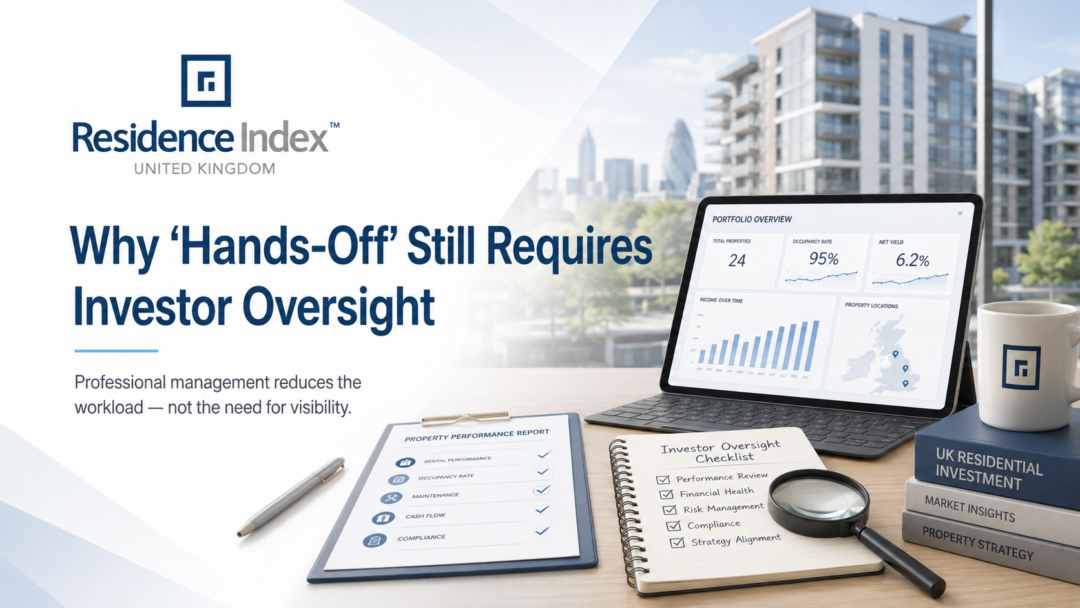
Why Hands-Off Property Investment Still Needs Oversight
Why “Hands-Off” Still Requires Investor Oversight
Hands-off property investment is attractive for an obvious reason.
You own the asset, receive the income and allow professional managers to handle much of the day-to-day work.
No late-night maintenance calls.
No chasing tenants.
No arranging contractors from another city — or another country.
For busy professionals, business owners and overseas investors, that can be one of the strongest arguments for professionally managed property.
But “hands-off” should never mean “eyes-off”.
Professional management can reduce operational involvement. It cannot remove the investor’s responsibility to understand whether the asset is still performing as expected.
The most effective hands-off investors are often not the ones doing the most work.
They are the ones monitoring the right information.
Hands-Off Property Investment Is Delegation, Not Disengagement
There is an important distinction between delegating a task and surrendering visibility over it.
A property manager may handle:
- rent collection;
- tenant communication;
- maintenance coordination;
- inspections;
- tenancy administration;
- contractor appointments;
- renewals;
- check-outs; and
- reletting.
That can substantially reduce the workload attached to ownership.
As discussed in our guide to why completed and tenanted assets appeal to time-poor investors, established management and an existing tenancy can make property ownership significantly more manageable.
However, an investor should still know:
- what rent is being collected;
- whether that rent remains competitive;
- how often the property is vacant;
- what maintenance is costing;
- whether service charges are changing;
- how quickly problems are resolved;
- what the management company is charging; and
- whether the original investment assumptions remain realistic.
Hands-off ownership should remove unnecessary activity.
It should not remove information.
Start With the Management Agreement
The first layer of oversight should begin before the property is even managed.
Understand the agreement.
A management fee advertised as 8%, 10% or 12% tells you only part of the story.
Additional charges may apply for inspections, inventories, tenancy renewals, maintenance administration, notices, contractor coordination or reletting.
There may also be limits on when the investor must approve expenditure and when the manager can authorise work automatically.
We examine these issues in greater detail in What a Management Agreement Can Quietly Do to Your Returns.
The objective is not to interfere with every management decision.
It is to know the framework within which those decisions are being made.
An investor should understand:
- which costs require approval;
- whether contractor mark-ups apply;
- when rental income is remitted;
- what reporting is provided;
- how repair emergencies are handled;
- what happens during void periods; and
- how the management agreement can be terminated.
A manager cannot be properly assessed if the investor does not know what the manager has actually agreed to deliver.
Build a Simple Investor Dashboard
Oversight does not require a complicated spreadsheet containing 40 different metrics.
For many investors, a simple monthly or quarterly dashboard is enough.
Consider monitoring:
Rent received
Compare actual rent received with the amount expected.
A small difference might be explained by timing.
A recurring difference needs investigation.
Occupancy
One short void may be normal.
Repeated or increasingly long void periods could suggest pricing, management or local demand issues.
Net income
Gross rent is useful.
Net income is more important.
Track what remains after management charges, service charges, maintenance, insurance and other operating costs.
Maintenance expenditure
Individual repairs are part of property ownership.
A trend of increasingly frequent repairs deserves closer attention.
Service charges
Service charges can materially influence the economics of apartment ownership.
Compare annual changes rather than simply paying each invoice automatically.
Rent against the local market
An occupied property can still underperform if the rent has fallen materially behind comparable homes.
Our article on why investors should track rent per square foot explains another useful way to compare rental performance rather than relying solely on headline monthly rent.
The dashboard should answer one basic question:
Is the property performing broadly as expected?
If the answer changes, investigate.
Monitor the Manager, Not Every Maintenance Call
One of the fastest ways to destroy the benefit of professional management is to start managing the manager minute by minute.
That is unnecessary.
Instead, assess outcomes.
For example:
Are statements delivered when promised?
Are tenants’ issues being resolved promptly?
Are maintenance costs clearly explained?
Are contractors being used sensibly?
Are void periods reasonable?
Are rental reviews being considered?
Are important issues escalated quickly?
Is communication clear?
Professional management should create a reporting system that gives the investor confidence without requiring constant intervention.
For letting and property management agents in England that hold client money, the Government also requires membership of an approved client money protection scheme. Investors can use the official GOV.UK guidance on client money protection when carrying out basic checks on a management provider.
Good oversight therefore looks less like micromanagement and more like governance.
Legal Responsibilities Do Not Disappear Because a Manager Is Appointed
Investors should also distinguish between outsourcing administration and eliminating legal responsibility.
For properties in England, GOV.UK identifies landlord responsibilities covering areas including property safety, gas and electrical equipment, Energy Performance Certificates and tenant deposits.
A professional agent may arrange much of the practical compliance work.
However, investors should still understand what must happen and confirm that appropriate systems are in place.
The official GOV.UK landlord responsibilities guidance provides a useful starting point.
For a hands-off investor, this does not necessarily mean personally organising every certificate or inspection.
It means knowing that they exist, understanding who is responsible for arranging them and confirming that the process is working.
That distinction matters.
Outsourcing the task should increase control over the process, not create a blind spot.
Review Costs Before They Become Normal
One danger of passive ownership is cost creep.
Suppose a property gradually accumulates:
- higher service charges;
- higher management fees;
- maintenance administration costs;
- more frequent repairs;
- insurance increases; and
- longer periods between tenancies.
No single increase may look dramatic.
Together, they can steadily reduce the net return.
This is why investors should review the economics at least periodically rather than focusing only on whether rent arrived that month.
Compare:
Original expected annual income
against
Actual annual income
Then compare:
Original expected annual costs
against
Actual annual costs
Finally calculate the resulting net position.
If the investment was originally selected for simplicity and predictable income, that simplicity should still be visible in the numbers.
Our earlier analysis of why more landlords are choosing simplicity over yield explains why operational friction can matter just as much as headline rental yield.
Revisit the Original Investment Case
A useful investment decision should have an evidence trail.
Why did you buy this property?
Was it because of:
- local employment growth;
- rental demand;
- regeneration;
- limited supply;
- transport investment;
- tenant demographics;
- a particular development;
- income potential; or
- longer-term capital growth?
Those assumptions should not disappear once the purchase completes.
Our guide to building a property investment evidence file before reserving encourages investors to separate verified information from assumptions before committing capital.
That file can remain useful after completion.
Periodically ask:
Has anything important changed?
Perhaps the surrounding area is developing faster than expected.
Perhaps competing rental supply has increased.
Perhaps the tenant profile is evolving.
Perhaps actual rents have exceeded the original assumptions.
Or perhaps one of the original reasons for buying the property is becoming weaker.
Oversight means noticing those changes while there is still time to respond.
A Quarterly Review Can Be Enough
Hands-off investors do not necessarily need weekly reports.
For a stable property, a structured quarterly review may provide sufficient visibility.
A straightforward review could include:
Income
- Rent collected
- Arrears
- Current rent versus market rent
Occupancy
- Days occupied
- Void periods
- Upcoming tenancy dates
Costs
- Management
- Service charges
- Repairs
- Insurance
- Other significant expenditure
Property
- Outstanding maintenance
- Inspection findings
- Upcoming major works
Management
- Response quality
- Reporting
- Tenant issues
- Contractor performance
Investment
- Current comparable rents
- Relevant sales evidence
- Local market changes
- Original investment assumptions
That may take less than an hour.
Yet it can reveal considerably more than simply checking whether money has arrived in your bank account.
Know When to Intervene
Good hands-off ownership requires restraint.
Not every variance deserves action.
A £150 repair does not automatically indicate poor management.
A two-week void does not necessarily indicate weak demand.
One tenant complaint does not mean the manager is failing.
Look for patterns.
Intervention becomes more appropriate when you see repeated issues such as:
- unexplained charges;
- persistent arrears;
- unusually long voids;
- recurring maintenance problems;
- poor communication;
- inadequate reporting;
- significant rent underperformance;
- unexpected service-charge increases; or
- repeated failures to follow agreed processes.
That is when hands-off ownership should become temporarily more hands-on.
The purpose of oversight is not to interfere.
It is to recognise when intervention is justified.
The Best Hands-Off Investments Make Oversight Easier
Some assets are naturally easier to monitor than others.
Clear management arrangements help.
Transparent charges help.
Regular statements help.
Strong tenant demand helps.
Well-maintained buildings help.
Reliable reporting helps.
Investors comparing professionally managed opportunities can review the current Residence Index UK property portfolio and assess not only the projected yield, but also the operational structure surrounding each investment.
Because a genuinely convenient investment is not one you never hear about.
It is one where the information you receive gives you very little reason to worry.
Final Thoughts
Hands-off property investment can be a highly practical strategy for investors who value their time.
Professional management can remove much of the administrative burden associated with being a landlord.
But good delegation still requires oversight.
Monitor the income.
Monitor the costs.
Monitor the manager.
Monitor the asset.
And periodically revisit the reasons you bought it.
The objective is not to become a full-time landlord.
It is to remain an informed owner.
That is the difference between an investment that is professionally managed and one that is simply ignored.
For more property investment analysis, explore the Residence Index UK blog or browse our latest UK property opportunities.
Important: Property investment involves risk. This article is for general information only and does not constitute legal, tax, mortgage or financial advice. Investors should obtain appropriate independent professional advice for their circumstances.