
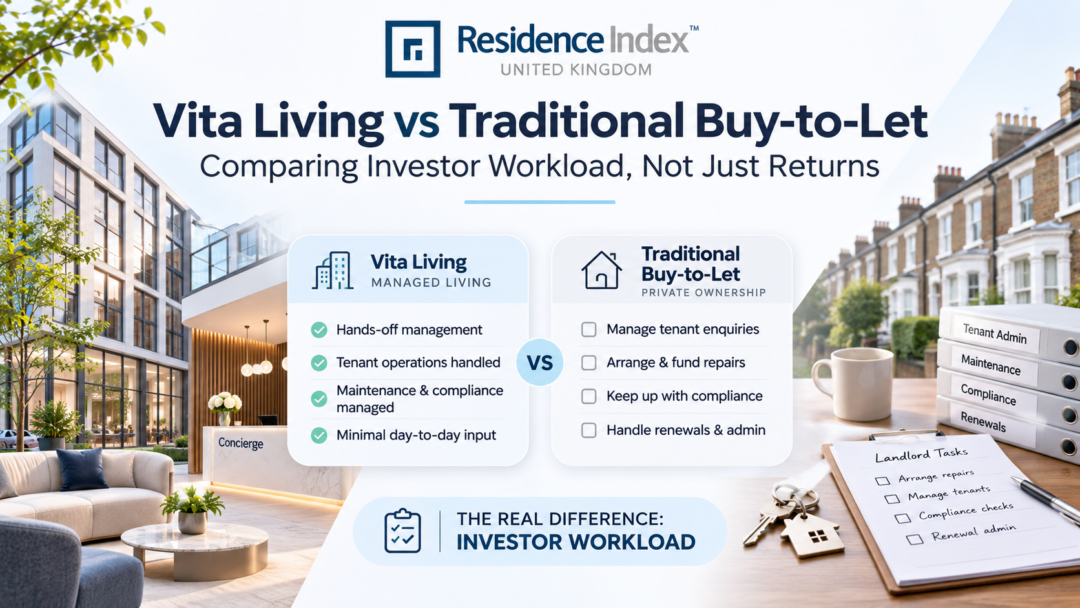
Vita Living vs Traditional Buy-to-Let | Investor Workload
Vita Living vs Traditional Buy-to-Let: Comparing Investor Workload, Not Just Returns
Two properties can offer similar rental yields but deliver very different ownership experiences.
One investor might spend evenings arranging repairs, reviewing tenant applications and following up on late rent.
Another might receive regular management reports, approve occasional expenditure and spend relatively little time on daily operations.
Both own rental property.
Both face investment risk.
But their workloads are not the same.
This distinction matters when comparing Vita Living vs traditional buy-to-let, particularly for overseas buyers, business owners and investors who value their time.
The important question is not simply which property could generate the higher return.
It is how much work, responsibility and management oversight each investment requires to produce that return.
1. Traditional Buy-to-Let: The Investor as Operator
Traditional buy-to-let offers investors flexibility.
You can choose the location, property type, letting strategy, contractors and level of management involvement.
However, those decisions create operational responsibilities.
Depending on the management arrangement, landlords may need to oversee:
- Tenant marketing and referencing.
- Rent collection and arrears.
- Repairs and maintenance.
- Property inspections.
- Safety and regulatory compliance.
- Tenant communications.
- Void periods and re-letting.
- Insurance, budgets and ongoing expenditure.
Some landlords enjoy this level of control.
Others discover that owning one or two rental properties can require more time than expected.
Even when the investment performs financially, the operational workload may be substantial.
Importantly, traditional buy-to-let does not have to be self-managed. Investors can appoint professional letting agents to handle many of these activities.
As Propertymark explains in its guide to letting-agent services, management arrangements range from tenant-find services to rent collection and full property management.
The real comparison is therefore between different operating models, not simply between managed and unmanaged property.
2. Vita Living: A More Structured Management Model
Vita Living at Circle Square, Manchester offers a different proposition.
Situated within Manchester’s Oxford Road corridor, the completed development combines furnished residential apartments with established professional building operations.
Its resident offering includes:
- Concierge services.
- Co-working facilities.
- Resident lounges.
- Private dining spaces.
- Rooftop terraces.
- Professionally operated communal facilities.
Residence Index UK’s current property listing describes the development as an established rental asset with approximately 98% occupancy and marketed historical rental yields of around 6.5–7%.
These figures provide useful historical context, although they should not be treated as guaranteed future returns or assumed to apply equally to every apartment.
The distinction for investors is the building’s established operating structure.
Rather than assembling every part of the management process independently, an investor may benefit from existing systems for resident services, building operations and tenancy management.
However, the precise tasks handled for an individual apartment owner depend on the applicable management agreement.
Professional management can reduce daily involvement. It does not automatically remove ownership responsibilities.
3. Compare the Workload, Not Just the Yield
Consider the practical differences between three ownership approaches.
Responsibility | Self-Managed Buy-to-Let | Fully Managed Buy-to-Let | Vita Living Model |
Tenant enquiries | Owner | Agent | Operator/manager, subject to agreement |
Rent collection | Owner | Agent | Manager, subject to agreement |
Routine repairs | Owner coordinates | Agent coordinates | Agreed management process |
Communal facilities | Depends on property | Depends on property | Building operator |
Compliance oversight | Owner | Owner and agent | Owner and appointed parties |
Financial monitoring | Owner | Owner | Owner |
Major spending decisions | Owner | Owner, per authority limits | Owner, per contract |
Management costs | Potentially lower cash fees | Agency fees | Contractual fees and building costs |
The table illustrates typical arrangements rather than guaranteeing a particular service under a Vita Living purchase.
A well-managed traditional buy-to-let apartment could require just as little daily involvement as a professionally operated development.
The difference is how reliably each structure delivers that experience, at what cost and with how much flexibility.
4. What Does Professional Management Actually Remove?
For many investors, the greatest benefit of professional management is not eliminating every decision.
It is reducing the number of unexpected interruptions.
Imagine a tenant reports a leaking appliance.
With self-managed buy-to-let, the landlord may need to contact contractors, arrange access, approve the repair and follow up afterwards.
With an effective fully managed arrangement, the manager can coordinate much of that work.
In a professionally operated residential development, established maintenance procedures may make routine coordination more systematic.
That can be particularly valuable for investors living outside the UK.
However, the owner may still be required to approve expenditure above an agreed threshold, fund repairs and monitor whether the work represents reasonable value.
The benefit is therefore better delegation, not complete detachment.
5. The Responsibility That Does Not Disappear
A common misconception is that fully managed property means the investor has no remaining responsibilities.
That is not the case.
The UK government’s landlord responsibilities guidance explains the duties associated with renting out residential property, including maintaining safe accommodation and meeting relevant safety requirements.
England’s Renters’ Rights Act tenancy reforms also took effect on 1 May 2026, changing important requirements for landlords and agents.
Investors should understand the applicable rules and confirm how the manager carries out delegated duties.
See the government’s current Renters’ Rights Act guidance.
Regardless of management style, investors still need to monitor:
- Rental performance and arrears.
- Repair expenditure.
- Compliance arrangements.
- Property condition.
- Insurance.
- Financial reporting.
- Tax obligations.
- Longer-term capital expenditure.
The management agreement should clearly explain which duties are delegated, which approvals remain with the owner and how compliance is evidenced.
6. Management Fees Are Only Part of the Cost
A lower-workload investment is not automatically the most profitable.
Investors need to examine the full financial structure.
For an apartment, potential costs include:
Management fees: Charges for tenancy administration, rent collection and property management.
Service charges: Contributions towards operating, maintaining and repairing communal building facilities.
Maintenance costs: Repairs and replacement of items within the apartment.
Void costs: Rental income lost between tenancies.
Financing and tax: Mortgage interest, applicable taxes and other ownership expenses.
These costs are not interchangeable.
For example, a service charge covering building facilities is generally separate from a letting management fee.
A property with extensive amenities may provide an attractive resident experience while also carrying meaningful operating costs.
Investors should compare those costs against actual rental performance.
Our detailed guide, What a Property Management Agreement Can Quietly Do to Your Returns, explains why the headline management percentage rarely tells the entire story.
7. Investor Time Has an Economic Value
Suppose two properties produce identical net rental income before accounting for the owner’s time.
Property A requires the investor to coordinate contractors, chase information and make regular operational decisions.
Property B requires a monthly financial review and occasional approval of significant expenditure.
Even if the reported cash returns are equal, the ownership experiences are different.
For a busy professional, those saved hours may be valuable.
For a hands-on investor with local contacts, direct involvement may be preferable because it provides greater operational control.
Neither approach is universally better.
The important point is that time and management capacity are resources, just like capital.
A property should fit the investor’s ability and willingness to manage it.
8. Vita Living’s Operating History Adds Useful Evidence
One reason Vita Living is interesting is that it is a completed development with an established rental operating history.
That is different from evaluating a building entirely on projections.
Its reported occupancy provides evidence of historical tenant demand.
However, investors should still examine the performance of the specific apartment they intend to purchase.
Relevant questions include:
- What is the actual rent achieved by comparable apartments?
- What period does the occupancy figure cover?
- How frequently do tenants move?
- What incentives have been offered?
- How long do comparable apartments remain vacant?
- What are the actual management and service charges?
A high building-level occupancy rate does not guarantee that every individual apartment will perform identically.
Our Vita Living occupancy case study explores the distinction between operating evidence and investment certainty.
9. The Trade-Off: Convenience Versus Control
Every management model involves a trade-off.
Traditional self-managed buy-to-let can provide greater control over contractors, maintenance schedules, property presentation and operating expenditure.
However, that freedom also brings responsibility.
Professionally managed developments can offer more structured day-to-day operations.
In exchange, investors may have less discretion over some processes, suppliers and communal expenditure.
This is not necessarily a disadvantage.
Consistent management can protect the resident experience and support the building’s long-term condition.
But investors must understand the restrictions and costs before committing.
Ask whether management arrangements are compulsory, whether they can be changed, how charges are reviewed and what rights owners have over major expenditure.
10. Five Questions Before Choosing Either Model
Before comparing projected yields, establish:
- How many hours will ownership realistically require?
Separate routine oversight from exceptional repairs, tenant changes and major expenditure.
- Who handles tenant problems?
Identify the first point of contact and the process for escalating unresolved issues.
- Who controls spending?
Understand repair approval limits, contractor selection and service-charge obligations.
- What reporting will I receive?
Expect clear statements covering rental receipts, deductions, arrears and maintenance.
- Can the investment still work if costs increase?
Stress-test higher service charges, repairs, vacancy and slower rental growth.
These questions help investors understand the ownership experience before they encounter it.
For further due diligence, explore the Residence Index UK property portfolio and our property investment insights.
Final Thought: The Best Return Must Fit Your Lifestyle
Vita Living and traditional buy-to-let should not be compared on headline yield alone.
One investor may be comfortable managing repairs and tenants personally.
Another may prefer a professionally structured investment with fewer daily interruptions.
Both approaches can be appropriate when the finances, responsibilities and risks are understood.
The better question is not:
Which investment requires the least work?
It is:
Which investment offers an acceptable net return for the amount of work, capital and responsibility I am prepared to take on?
Explore Vita Living at Circle Square and consider how its operating model compares with your investment objectives.
Disclaimer: This article is for general information only and is not financial, legal or tax advice. Property performance, management services, fees and legal responsibilities must be verified for the specific investment.