
Property Management Fees UK: Compare 3 Pricing Models
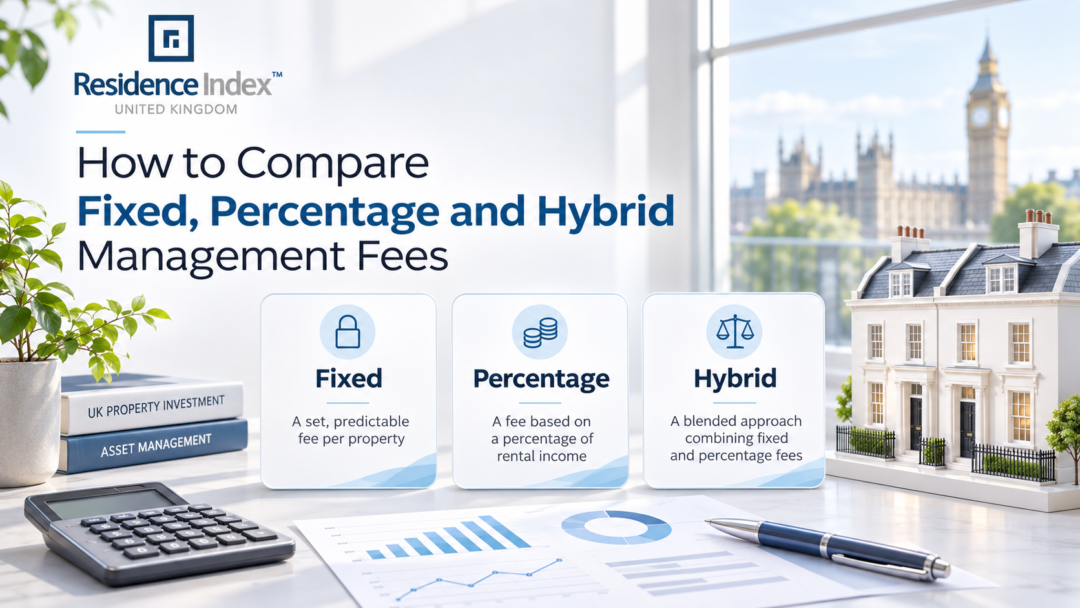
How to Compare Fixed, Percentage and Hybrid Management Fees
The cheapest management fee is not always the cheapest management arrangement.
When comparing property management fees in the UK, landlords often focus on one number: the monthly charge.
One agent offers a fixed monthly fee. Another charges a percentage of rent. A third proposes a hybrid arrangement combining both.
The offers may look easy to compare.
However, the structure of the fee can affect cash flow, vacancy costs, administrative expenses and the amount of work an investor must handle personally.
For landlords managing UK properties from overseas, those differences can become particularly important.
The objective is not simply to find the lowest fee. It is to understand what each arrangement costs, what it covers and how it performs under different circumstances.
1. Fixed Management Fees: Predictable, but Not Always Flexible
A fixed management fee is a predetermined amount charged periodically, usually monthly.
For example:
- Monthly rent: £1,500
- Fixed management fee: £175 per month
- Annual fee: £2,100
All figures in this example include VAT where applicable.
The main advantage is predictability.
If rental income increases, the management fee may remain unchanged.
This can make fixed fees attractive for properties generating higher rents.
However, investors need to establish whether the fee continues during vacant periods.
A landlord could potentially pay the same management charge even when no rent is coming in.
Questions worth asking:
- Does the monthly fee apply during vacancies?
- Are tenant-finding and referencing included?
- Are inspections and maintenance coordination included?
- Can the fixed price increase during the contract?
A fixed fee can simplify budgeting, but only when its coverage and conditions are clear.
2. Percentage Management Fees: Costs That Move With Rent
Percentage-based fees are calculated using an agreed proportion of rental income.
For example:
- Monthly rent: £1,500
- Management fee: 11% of collected rent, including VAT
- Monthly management cost: £165
- Annual cost at full occupancy: £1,980
One potential benefit is that the management fee rises and falls with rental income.
If the agreement charges only on rent actually collected, the percentage component may reduce to zero during a vacancy.
However, investors should not assume that all percentage arrangements work this way.
Some agreements calculate charges differently, and separate letting fees may still apply.
Check the exact calculation:
Is the percentage charged on rent due, rent received or another amount?
Does it include VAT?
Are there minimum monthly charges?
Is the percentage still payable when the original agent no longer manages the tenancy?
These details can affect the true cost considerably.
3. Hybrid Fees: A Base Charge Plus a Percentage
Hybrid management fees combine a fixed payment with a percentage-based component.
An illustrative arrangement might be:
- Fixed monthly charge: £75
- Variable fee: 6% of rent collected
- Monthly rent: £1,500
- Total monthly fee: £165
- Annual cost at full occupancy: £1,980
Again, all example charges include VAT where applicable.
The fixed element may cover ongoing administration, while the percentage element varies with rental income.
However, each provider determines its own service package.
The critical question is what happens when the property becomes vacant.
For example, the £75 monthly base charge might remain payable even when the percentage component falls to zero.
A hybrid arrangement can provide a balance between predictable charges and rental-linked pricing, but it is not automatically the best-value option.
4. Compare All Three Using the Same Property
Consider a UK apartment generating £1,500 per month.
Annual gross rental income would be £18,000, assuming 12 months of full occupancy.
Here is a simplified comparison.
Fee Structure | Monthly Cost | Annual Cost |
Fixed: £175/month | £175 | £2,100 |
Percentage: 11% | £165 | £1,980 |
Hybrid: £75 + 6% | £165 | £1,980 |
All fees are illustrative and VAT-inclusive.
At this rental level, the percentage and hybrid models have identical annual costs.
But that does not mean they represent identical value.
One provider might include routine inspections, tenancy administration and maintenance coordination.
Another might charge separately for the same services.
The headline fee does not tell you what is actually included.
This is why investors should review the property management agreement and its effect on returns before choosing an agent.
5. Stress-Test the Fees Against a Vacancy
Suppose the same apartment experiences one vacant month during the year.
Assume the fixed monthly fee and hybrid base charge continue throughout the vacancy, while percentage charges apply only to rent collected.
Fee Structure | Annual Cost With One Vacant Month |
Fixed | £2,100 |
Percentage | £1,815 |
Hybrid | £1,890 |
The percentage model now has the lowest management charge.
However, the landlord has also lost £1,500 in gross rent.
That rental loss is much more significant than the difference between management fees.
This demonstrates why investors should assess management arrangements alongside occupancy assumptions, rather than treating them as an isolated expense.
6. Identify the Additional Charges
Two management agreements can advertise similar monthly fees while delivering substantially different total costs.
Potential additional charges include:
- Tenant finding and referencing
- Inventory preparation and check-out
- Routine or additional inspections
- Maintenance administration
- Contractor coordination or mark-ups
- Rent reviews and tenancy administration
- Compliance-related services
- Termination or handover charges
These charges are not automatically unreasonable.
The important issue is whether they are clearly disclosed, appropriately priced and relevant to the services required.
UK government consumer protection guidance for lettings professionals emphasises clear descriptions of services, transparent charges and VAT-inclusive fee information.
Landlords should request the full fee schedule and terms of business before signing.
7. Compare Service Quality, Not Just Pricing
A management company does more than collect rent.
Depending on the contract, its responsibilities may include communicating with tenants, organising repairs, managing access, monitoring payments and maintaining records.
For an overseas investor, the quality of those processes can matter more than a small difference in monthly charges.
Ask how the agent handles:
Maintenance: Who authorises repairs, and what spending limits apply?
Communication: How quickly will the landlord receive updates?
Rent collection: When is rent transferred, and how are arrears managed?
Reporting: Are monthly statements and supporting invoices provided?
Tenancy changes: Who handles move-outs, marketing and new tenant onboarding?
Exiting the agreement: What notice period and handover fees apply?
An inexpensive arrangement that leaves significant administrative work with the investor may provide less value than a more comprehensive service.
8. Check the Agent’s Protections and Compliance
Before selecting a managing agent in England, investors should confirm relevant professional and regulatory safeguards.
These include membership of a government-approved redress scheme and, where the agent holds client money, an approved client money protection scheme.
The rules are explained in the official guidance on redress schemes and client money protection.
Investors should also remember that management fees are separate from building service charges, repairs, insurance, mortgage costs, taxes and other ownership expenses.
Understanding those distinctions is essential when calculating realistic rental returns.
9. Build a 12-Month Management Cost Comparison
A practical approach is to ask each prospective managing agent for a written estimate covering the same 12-month period.
Include:
- Standard monthly management charges
- VAT, where applicable
- Tenant-finding and onboarding fees
- Routine administration and inspections
- Potential maintenance administration charges
- Costs during a vacant month
- Termination and handover conditions
Use the same assumptions for every provider.
Then compare the total annual expense, services included and responsibilities retained by the landlord.
A clear comparison can form part of your wider property investment evidence file.
10. The Best Fee Structure Depends on Your Property
There is no universal winner.
A fixed fee may suit a higher-rent property where predictable costs are valuable.
A percentage arrangement may appeal to an investor who prefers charges linked to rent collection.
A hybrid structure may suit an investor seeking a mixture of fixed administration and variable pricing.
But any of these models can become expensive if the agreement contains additional charges, weak service standards or restrictive termination conditions.
Before deciding, consider the expected rental income, likelihood of vacancy, amount of support required and quality of the provider.
The right question is not simply, “How much does management cost?”
It is:
“What am I paying for, and how does the agreement protect my investment?”
Final Thoughts
Property management should be evaluated as part of the overall investment strategy.
A well-structured agreement can make ownership easier, improve operational oversight and reduce avoidable administrative problems.
A poorly understood agreement can quietly erode rental returns.
At Residence Index UK, we encourage investors to evaluate the full ownership picture, not just the headline yield.
Explore our UK investment properties or visit our property investment blog for more practical guidance.
Disclaimer: Figures are illustrative and do not represent actual quotations or guaranteed returns. Regulatory references in this article primarily concern England; requirements elsewhere in the UK may differ.