
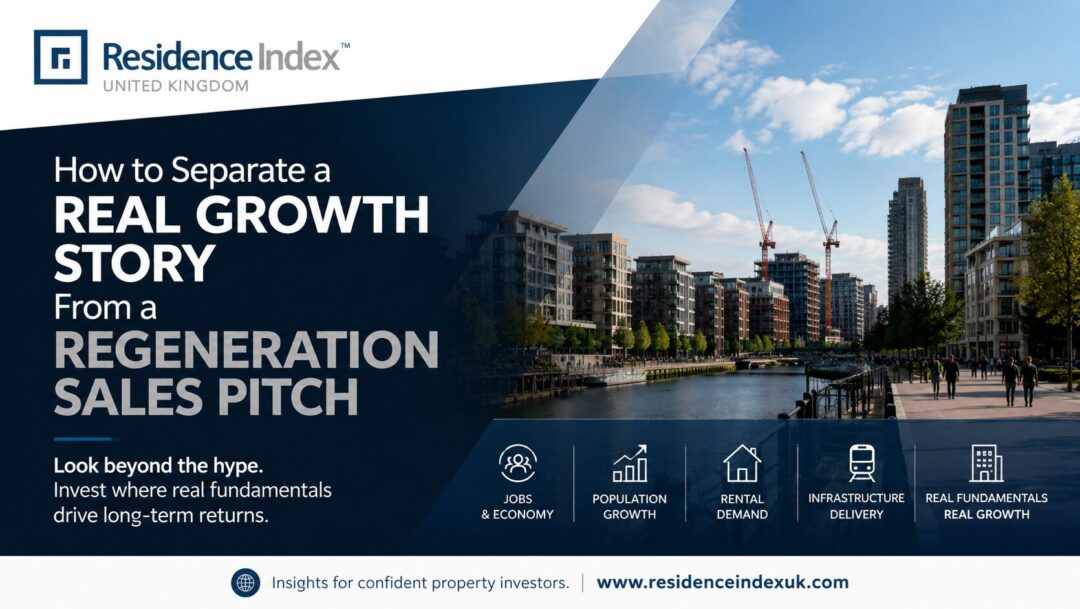
How to Separate a Real Growth Story From a Regeneration Sales Pitch | Residence Index UK
How to Separate a Real Growth Story From a Regeneration Sales Pitch
The word “regeneration” appears in almost every property brochure today.
New transport links. New shopping districts. New public spaces. New investment zones.
While regeneration can create outstanding investment opportunities, it is not a guarantee of future property growth.
Many investors make the mistake of believing that regeneration alone will drive strong capital appreciation and rental demand. In reality, successful property investment depends on a much broader picture.
The best investors know how to distinguish between a genuine growth story and a marketing narrative.
Here’s how.
Regeneration Is a Positive Sign — Not Proof
Regeneration improves places.
It can include:
- New transport infrastructure
- Public realm improvements
- Commercial developments
- Universities
- Healthcare facilities
- Leisure and retail investment
These projects often make an area more attractive.
However, attractive does not automatically mean profitable.
Some regeneration projects transform entire cities.
Others make very little difference to long-term property values.
The question isn’t whether regeneration exists.
The question is whether it changes the local economy.
Look Beyond the Artist’s Impressions
Sales brochures often focus on:
- Beautiful CGI images
- Lifestyle branding
- Future masterplans
- Proposed developments
These are designed to create excitement.
Professional investors ask different questions.
Instead of asking:
“What will be built?”
They ask:
“Who will actually live here?”
Rental demand drives long-term performance far more consistently than attractive marketing images.
Follow the Jobs
The strongest regeneration stories are driven by employment.
When companies create thousands of new jobs, demand for housing usually follows.
Look for evidence such as:
- Expanding business districts
- Major employers relocating
- Growth in financial services
- Technology clusters
- Life sciences
- Advanced manufacturing
- Universities expanding student numbers
Jobs create tenants.
Tenants create rental demand.
Rental demand supports long-term property values.
Population Growth Matters More Than Construction
Some cities build more homes because they expect people to arrive.
Others build homes despite little population growth.
That difference matters.
Look for cities where:
- Population is increasing
- Graduate retention is improving
- International migration remains strong
- Young professionals are staying after university
Growing populations create long-term housing demand.
Without people, regeneration has limited impact.
Infrastructure Should Connect People to Opportunity
A new railway station sounds impressive.
But ask:
- Does it shorten commuting times?
- Does it connect residents with employment?
- Does it improve accessibility?
- Does it encourage businesses to relocate?
Infrastructure only creates value when it improves economic activity.
Transport links should support employment, education and business growth—not simply look impressive on a map.
Examine Rental Demand
Rental demand tells you what is happening today.
Look for evidence such as:
- Low vacancy rates
- Rising rents
- Strong tenant competition
- High occupancy
- Limited housing supply
These indicators often reveal more than regeneration announcements.
Strong rental markets usually reflect genuine demand rather than speculation.
Understand Who Is Funding the Regeneration
Not every regeneration project carries the same level of certainty.
Ask questions such as:
- Is funding already secured?
- Has construction begun?
- Is the project government-backed?
- Are private developers already delivering?
Projects that exist only on paper carry greater uncertainty.
Completed investment generally carries far more weight than proposed investment.
Look for Multiple Growth Drivers
The best-performing property markets rarely depend on one single project.
Instead, they benefit from several factors working together.
Examples include:
- Employment growth
- Population growth
- Universities
- Transport improvements
- Housing shortages
- Private investment
- Business expansion
When several growth drivers align, long-term resilience improves significantly.
Beware of Marketing Buzzwords
Certain phrases appear repeatedly in property marketing.
Examples include:
- “The next hotspot”
- “Up-and-coming area”
- “Huge regeneration plans”
- “Future investment zone”
- “Massive capital growth”
These statements may prove correct.
But they are not evidence.
Always look for supporting data before making an investment decision.
Real Growth Leaves Evidence
The strongest property markets show measurable progress.
Look for:
- Rising employment
- Increasing rental demand
- Population growth
- Infrastructure already under construction
- Business investment
- Strong local economies
When these factors combine, regeneration becomes part of a broader growth story rather than the entire investment case.
Final Thoughts
Regeneration should never be ignored.
It can create excellent opportunities for investors who understand what truly drives long-term property performance.
But successful investing requires looking beyond attractive brochures and ambitious masterplans.
The most resilient investments are supported by strong economic fundamentals, sustained tenant demand and multiple long-term growth drivers.
Rather than asking whether an area is being regenerated, ask whether it is becoming a better place to live, work and build a future.
That distinction often separates successful investors from those who simply follow the latest sales pitch.
Explore UK Investment Opportunities
Browse carefully selected developments across the UK on the Residence Index UK property portal:
https://www.residenceindexuk.com/residence-index-uk-properties/
You can also read more investor insights on our blog:
https://www.residenceindexuk.com/bloglist/
Recommended Internal Articles
Continue your reading with these related guides:
- https://www.residenceindexuk.com/the-biggest-lie-in-uk-property-investing/
- https://www.residenceindexuk.com/why-cheap-property-often-becomes-the-most-expensive-mistake/
- https://www.residenceindexuk.com/the-hidden-cost-nobody-talks-about-in-property-investing/
- https://www.residenceindexuk.com/why-more-landlords-are-choosing-simplicity-over-yield/
- https://www.residenceindexuk.com/what-smart-property-investors-are-doing-differently-in-2026/
- https://www.residenceindexuk.com/why-rental-demand-can-be-strong-while-the-wrong-flat-still-struggles/
- https://www.residenceindexuk.com/the-10-minute-investment-brief-every-buyer-should-write-before-viewing-a-deal/
Authoritative External References
For further research, these organisations provide valuable market data:
- Office for National Statistics (ONS) – Population, employment and regional economic data
https://www.ons.gov.uk/ - UK Government Levelling Up Programme
https://www.gov.uk/government/collections/levelling-up-fund - Savills UK Research
https://www.savills.co.uk/research/ - CBRE UK Research
https://www.cbre.co.uk/insights - JLL UK Research
https://www.jll.co.uk/en/trends-and-insights/research
Conclusion
Regeneration can be a valuable catalyst for property investment, but it is rarely the whole story. By focusing on employment, population growth, rental demand, infrastructure, and economic fundamentals, investors can identify locations where growth is supported by real evidence rather than marketing promises. A disciplined, research-led approach is far more likely to deliver sustainable long-term returns than chasing every regeneration headline.