Green Space Rental Premium in City Centres | RIUK
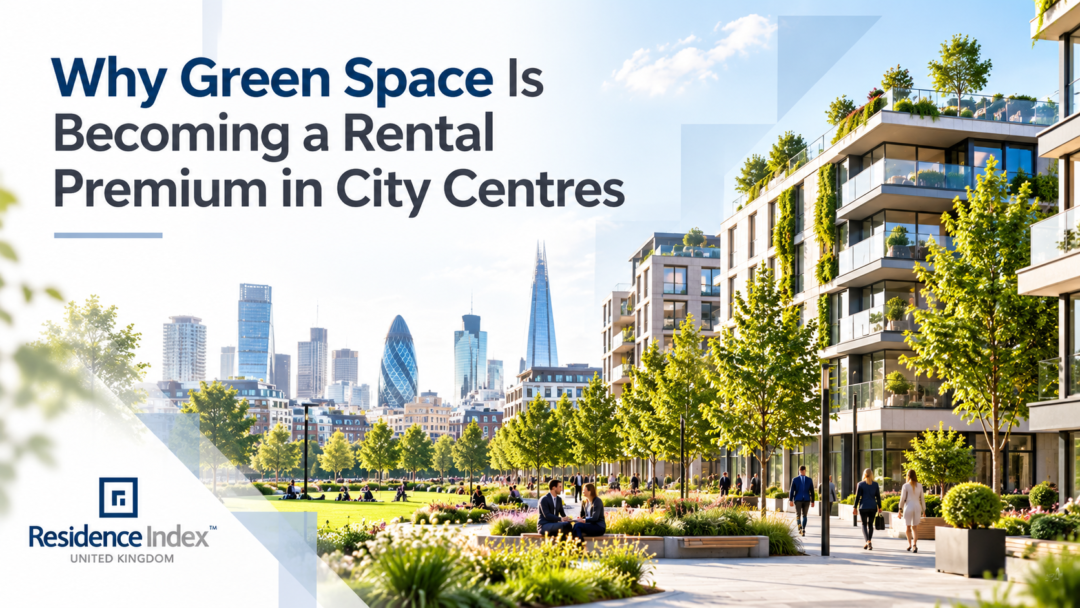
Why Green Space Is Becoming a Rental Premium in City Centres
For years, the traditional city-centre property investment formula was relatively straightforward.
Buy close to employment.
Buy close to transport.
Buy where tenants can walk to restaurants, shops and entertainment.
Those fundamentals still matter.
But another factor is becoming increasingly important in the way tenants assess urban living:
access to green space.
Parks, landscaped courtyards, roof gardens, terraces, trees and accessible outdoor areas are no longer simply attractive additions to a development.
For some tenants, they can meaningfully improve the experience of living in a dense city centre.
For investors, that raises a more interesting question:
Can green space create a genuine rental premium?
The answer can be yes — but investors need evidence rather than assumptions.
City-Centre Living Has a Trade-Off
City-centre apartments offer obvious advantages.
Residents may benefit from shorter commutes, better public transport, restaurants, entertainment, employment and walkability.
But density creates compromises.
Many city-centre tenants have:
- no private garden;
- limited balconies;
- smaller apartments;
- busy streets outside;
- less distance from neighbouring buildings; and
- relatively little private outdoor space.
That makes accessible green space more valuable precisely because it is scarce.
A park five minutes from an apartment may therefore matter more to an urban tenant than a similar park does to somebody living in a lower-density suburban neighbourhood.
The tenant is not necessarily paying for grass and trees.
They may be paying for contrast with the surrounding city.
Green Space Has Become Part of the Lifestyle Proposition
Natural England reports that more than 85% of people in England live in towns and cities, and has highlighted the role of urban green infrastructure in creating healthier, more resilient places to live.
Its 2026 work also notes that green infrastructure can reduce urban temperatures as extreme heat becomes more frequent.
This matters for property investors because tenants increasingly judge the wider living environment, not simply the apartment.
A renter may compare:
Apartment A
Central location
Modern kitchen
Good transport
No meaningful outdoor space nearby
with:
Apartment B
Central location
Modern kitchen
Good transport
Landscaped courtyard
Roof terrace
Large public park within walking distance
If the monthly rents are reasonably close, Apartment B has another reason to win the comparison.
Residence Index UK has previously examined this broader principle in Amenities Tenants Actually Use: The Investment Case.
Useful amenities can contribute to rent, occupancy, retention and overall competitiveness — but only when residents genuinely value them.
Green space should be analysed the same way.
Hybrid Working Has Made the Neighbourhood More Important
The apartment used to be somewhere many professionals left every weekday morning.
Hybrid working has changed that relationship.
A tenant working remotely two or three days each week may spend considerably more time around their home and immediate neighbourhood.
That can increase the value of:
- somewhere to walk at lunchtime;
- outdoor seating;
- access to trees and planting;
- space for exercise;
- dog-friendly areas;
- attractive walking routes; and
- places to decompress away from the apartment.
This does not mean every remote worker will pay a large premium for a park.
It means the neighbourhood’s quality has become a more important part of the rental product.
The distinction matters.
Investors are not simply buying an apartment.
They are buying an apartment inside a particular daily lifestyle.
Scarcity Is What Can Create the Premium
Green space is unlikely to create the same value everywhere.
If almost every competing property has excellent access to parks and landscaped areas, the feature becomes less distinctive.
The potential premium becomes more interesting where attractive outdoor space is scarce.
Imagine two clusters of city-centre apartments.
In one area, residents are surrounded almost entirely by roads, offices and high-density development.
In another, tenants have direct access to a substantial landscaped public space.
That difference may influence:
- enquiry levels;
- achieved rent;
- tenant demographics;
- length of tenancy;
- void periods; and
- future resale appeal.
Investors therefore need to think about green space as a micro-location characteristic, rather than a city-wide statistic.
Circle Square Shows Why the Combination Matters
Manchester’s Circle Square provides a useful example.
Vita Living at Circle Square sits within the Oxford Road Corridor and overlooks Symphony Park, while also offering rooftop terraces, co-working facilities and communal spaces.
The important point is not that Symphony Park alone creates the investment case.
It does not.
Circle Square combines several sources of tenant appeal:
employment, universities, transport, restaurants, culture, amenities and green space.
Our analysis of Circle Square Manchester: Jobs, Universities and Culture explains why the strength of the location comes from this overlap rather than one isolated feature.
That is how investors should assess green space.
A park becomes more powerful when it strengthens an already convenient location.
Employment + transport + apartment quality + amenities + green space is a much stronger proposition than green space trying to compensate for weak fundamentals.
Private Green Space Can Matter Too
Investors should not restrict the analysis to public parks.
Green space within a development can also influence tenant appeal.
That might include:
- landscaped courtyards;
- communal gardens;
- roof terraces;
- planted seating areas;
- podium gardens;
- garden terraces; or
- balconies overlooking greenery.
For example, Park Residence at Edition in Birmingham includes a garden terrace alongside its wider wellness and lifestyle amenity proposition.
That creates a different proposition from an apartment building where communal life is almost entirely indoors.
Residence Index UK has previously examined whether Park Residence at Edition’s wellness amenities can help defend premium rents.
The same test should apply to landscaped outdoor areas: tenants must value them enough for the feature to produce an economic benefit.
But Never Assume a Park View Equals More Rent
This is where investors need discipline.
Marketing language can easily turn:
“near a park”
into:
“premium green lifestyle”.
The rental evidence may tell a different story.
An apartment beside green space could still underperform because it has:
- a poor layout;
- limited natural light;
- excessive service charges;
- inconvenient transport;
- weaker building management;
- poor specification; or
- too much competing rental supply.
Green space is therefore one variable, not a substitute for investment fundamentals.
The correct question is not:
Does this development have green space?
It is:
Does the rental market demonstrate that tenants value this particular green space?
Use Rent per Square Foot to Test the Premium
One useful way to investigate the claim is rent per square foot.
Suppose comparable one-bedroom apartments without meaningful green-space access achieve around £2.40 per sq ft.
Similar apartments beside a major park consistently achieve £2.60.
That £0.20 difference is worth investigating.
But the investor should then control for other variables.
Are the apartments genuinely comparable?
Do the higher-rent properties also have:
- better kitchens;
- more efficient layouts;
- balconies;
- newer interiors;
- stronger management;
- superior transport access; or
- better views?
Our guide to Why Investors Should Track Rent per Square Foot explains why this measure can expose differences that headline monthly rents hide.
The goal is to isolate as much of the apparent green-space premium as possible.
Look Beyond Rent to Tenant Retention
Green space does not need to create a dramatic rental uplift to have investment value.
Suppose two apartments both achieve £1,700 per month.
One turns over tenants almost every year.
The other regularly keeps residents for two or three years.
The second property may produce better economics even though the headline rent is identical.
Lower turnover can potentially mean fewer:
- void periods;
- tenant-find fees;
- inventories;
- cleaning costs;
- minor refurbishments; and
- periods of marketing uncertainty.
If residents enjoy walking through a park every morning, using a landscaped courtyard or spending summer evenings on a garden terrace, that environment becomes part of their routine.
Moving means giving up more than the apartment.
That can potentially support retention.
City-Wide Rental Growth Is Not Enough Evidence
Rental markets remain supportive in several major UK cities.
According to the Office for National Statistics’ September 2026 private rental data, average UK monthly private rent reached £1,400 in August 2026, 3.8% higher than a year earlier.
In Birmingham, ONS local rental data showed an average monthly private rent of £1,099 in August 2026, up 3.0% year on year.
Those figures provide useful market context.
But they do not prove that an individual apartment beside a park deserves a premium.
Investors still need local comparable evidence.
Ideally, compare:
same area
similar building age
similar apartment size
similar specification
similar amenities
different relationship to green space
The tighter the comparison, the more useful the evidence becomes.
Measure Walking Time, Not Marketing Distance
“Close to a park” is vague.
Investors should measure what the tenant actually experiences.
There is a large difference between:
two minutes from the building entrance
and:
15 minutes away across several major roads.
Useful due diligence includes checking:
- actual walking route;
- entrance locations;
- road crossings;
- park opening hours;
- lighting;
- perceived safety;
- maintenance quality;
- size of the space;
- facilities available; and
- whether the route feels convenient in everyday use.
Distance alone does not determine value.
Accessibility does.
Views Can Create a Separate Premium
There is also a difference between access to green space and views over green space.
A tenant may value both.
Apartments overlooking parks or landscaped areas can sometimes benefit from:
- more attractive outlooks;
- a greater feeling of openness;
- improved privacy compared with facing another building;
- stronger natural light; and
- perceived scarcity.
But investors should again test the premium.
Compare rents within the same building if possible.
For example:
park-facing apartment versus city-facing apartment;
higher floor versus lower floor;
balcony versus no balcony.
Internal building comparisons can sometimes provide better evidence than comparing completely different developments.
Do Not Forget the Service Charge
Private landscaped gardens and terraces are not free.
They require:
- gardening;
- irrigation;
- cleaning;
- repairs;
- lighting;
- furniture maintenance; and
- long-term replacement budgets.
A beautifully landscaped development may achieve an additional £75 per month in rent.
But if the ownership structure creates an additional £1,500 per year in costs, the apparent premium may disappear.
Investors should therefore calculate:
Additional rental income
minus additional ownership costs
= potential net green-space benefit
That is much more useful than simply describing landscaping as “premium”.
This is the same principle behind analysing amenities tenants actually use: an attractive feature only becomes an investment advantage when the tenant value is sufficient to justify the investor cost.
Green Space May Also Help Future-Proof the Location
The investment case is not only about today’s tenant.
Natural England’s work on urban green infrastructure highlights benefits including urban cooling, climate resilience, nature recovery and improved access to green space.
Those factors could become increasingly relevant as cities become denser and climate risks receive greater attention.
A mature park, established landscaped neighbourhood or well-designed green public realm cannot always be replicated quickly.
That scarcity may strengthen the long-term attractiveness of certain micro-locations.
Again, it should not justify overpaying.
But investors assessing a property’s ten-year story should consider whether the surrounding environment is becoming more — or less — desirable.
The Investor’s Green-Space Test
Before paying a premium, ask:
- How close is the green space really?
Measure the actual walking route. - Is it genuinely attractive and usable?
A neglected patch of grass is not the same as a well-maintained park. - Is green space scarce nearby?
Scarcity can strengthen differentiation. - Do comparable rents show evidence of a premium?
Check achieved rents rather than asking rents where possible. - Can you isolate green space from other advantages?
Compare like with like. - Could it improve tenant retention?
Think beyond the first year’s rent. - Does private landscaping increase service charges?
Calculate the net benefit. - Will the space remain protected and maintained?
Investigate planned development nearby. - Does it fit the target tenant?
Professionals, families, pet owners and hybrid workers may value outdoor access differently. - Are you paying too much for the story?
A desirable feature does not make any purchase price sensible.
The Residence Index UK View
Green space is becoming increasingly relevant to the city-centre rental proposition.
But investors should resist turning that trend into another marketing shortcut.
The strongest properties are unlikely to succeed because they simply sit beside a park.
They succeed because several characteristics work together:
good location
strong transport
employment access
well-designed apartments
useful amenities
effective management
realistic pricing
and an environment tenants actually enjoy living in.
Green space can strengthen that package.
In dense city centres, where private outdoor space is limited and tenants increasingly assess their overall living experience, it may become an increasingly valuable point of differentiation.
The investment opportunity is therefore not:
Buy anything beside a park.
It is:
Identify where access to quality green space genuinely changes tenant behaviour — then determine whether the rental evidence justifies the price.
Investors looking to compare opportunities with these principles in mind can explore current Residence Index UK properties across Manchester, Birmingham, Liverpool and London.