
Regeneration Scheme Progress: 5 Signals to Watch
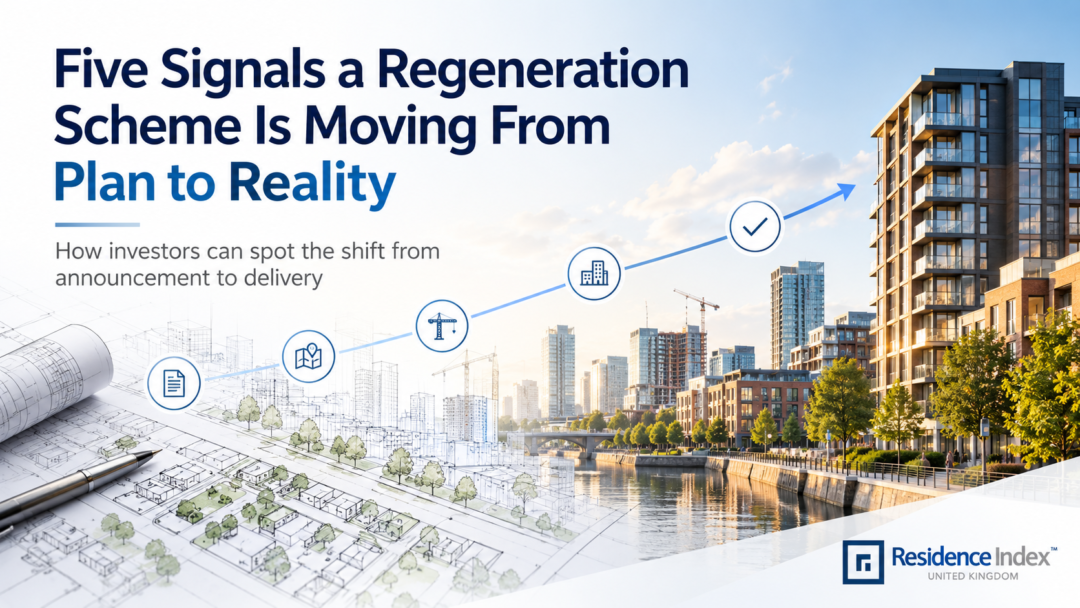
Five Signals a Regeneration Scheme Is Moving From Plan to Reality
Regeneration is one of the most commonly used stories in property investment.
A neighbourhood is going to be transformed.
New homes are coming.
Transport will improve.
Public spaces will be upgraded.
Employers will move in.
The difficulty is that regeneration can remain on a presentation slide for years.
For investors, the important question is therefore not simply whether a regeneration plan exists.
It is:
What evidence shows that the regeneration scheme is actually moving towards delivery?
Understanding regeneration scheme progress means separating announcements from commitments and commitments from physical change.
Here are five signals worth watching.
1. Money Has Moved From an Announcement to a Commitment
Large regeneration schemes need capital.
That may come from:
- central government;
- local authorities;
- combined authorities;
- institutional investors;
- developers;
- infrastructure providers; or
- partnerships between several of them.
However, there is an important difference between a headline saying that a scheme is expected to attract billions of pounds and actual funding being committed to specific pieces of delivery.
Investors should look for evidence such as:
- approved funding agreements;
- infrastructure grants;
- land purchases;
- remediation funding;
- development finance;
- signed joint ventures; and
- allocated budgets for specific phases.
Homes England’s current investment framework provides a useful illustration.
Its housing and infrastructure programmes can support land assembly, remediation, transport, utilities and other infrastructure needed to unlock housing and regeneration schemes.
Those are considerably stronger signals than an aspirational masterplan.
Funding does not guarantee that every element of a scheme will be delivered exactly as originally proposed.
However, committed capital creates a much stronger evidence base than promotional estimates of future investment.
Investor takeaway
Do not ask only:
“How much investment has been announced?”
Ask:
“What money has actually been committed, to whom, and for what?”
That distinction matters.
2. Planning Is Moving Into the Delivery Stage
Planning permission is important.
But investors should avoid treating planning approval as the finish line.
For a complex regeneration scheme, it is closer to one stage in a much longer process.
After planning permission, developers may still need to deal with:
- planning conditions;
- detailed designs;
- infrastructure agreements;
- highways matters;
- environmental requirements;
- remediation;
- utilities;
- building approvals; and
- phased delivery obligations.
One useful signal is therefore movement beyond the headline planning decision.
Look for planning conditions being discharged, reserved matters being approved and detailed applications appearing for individual phases.
Government planning guidance specifically recognises the discharge of conditions as part of the process around developments preparing to start or already progressing on site.
That means the planning portal can become surprisingly useful for investors.
Do not look only for:
Approved.
Look at what has happened afterwards.
A scheme with continuing technical applications and conditions being resolved is often showing more evidence of progression than one whose planning history has gone quiet.
This is particularly important when assessing off-plan property or investments whose wider location case depends heavily on future regeneration.
Before relying on those assumptions, build them into your property investment evidence file before reserving and record which elements are completed, under construction, funded, approved or merely proposed.
3. Contractors, Infrastructure Partners and Delivery Teams Appear
Another important shift happens when a regeneration scheme stops talking mainly about vision and starts talking about delivery.
Names begin appearing.
A contractor is appointed.
An engineering firm receives the infrastructure contract.
A development partner takes control of a particular phase.
Utilities works are commissioned.
Public-realm contracts are awarded.
These details can sound less exciting than a CGI showing the finished neighbourhood.
For investors, however, they may be far more valuable.
A regeneration scheme needs people and organisations contracted to build it.
Therefore, look beyond property marketing.
Search:
- council announcements;
- procurement notices;
- developer updates;
- infrastructure-provider announcements;
- construction-industry publications; and
- planning documents.
The important question is whether responsibility for delivery is becoming increasingly specific.
Compare these two statements:
“The area is expected to benefit from significant regeneration.”
versus:
“Funding has been approved, the infrastructure contract has been awarded and enabling works begin this year.”
They describe very different stages of certainty.
This is why investors should learn to separate a real growth story from a regeneration sales pitch.
The second story contains evidence that can be monitored.
The first contains primarily a prediction.
4. The Unexciting Work Starts
Cranes attract attention.
But some of the strongest evidence of regeneration progress may appear before the skyline visibly changes.
Look for:
- demolition;
- land clearance;
- groundworks;
- utility diversions;
- road construction;
- drainage;
- flood defences;
- site remediation;
- new access routes;
- landscaping preparation; and
- transport infrastructure.
This work is sometimes described as enabling infrastructure because it makes later development possible.
Homes England’s regeneration programmes specifically recognise activities such as land assembly, site preparation, remediation, utilities and transport infrastructure as ways of unlocking housing-led development.
That makes sense.
A brownfield site cannot become a functioning residential neighbourhood simply because someone has drawn apartments onto a masterplan.
The practical obstacles have to be removed.
For investors, this creates a useful way of analysing regeneration.
Instead of asking:
“Can I see finished buildings yet?”
ask:
“Are the obstacles preventing those buildings from being delivered actually being removed?”
This is especially useful with large multi-phase schemes.
The first visible change may not be a luxury apartment block.
It may be a road.
A park.
A bridge.
Utilities.
A cleared brownfield site.
Those investments can be important because they allow the next phases to happen.
5. People and Businesses Start Using the Place
The strongest stage of regeneration is when the area starts behaving differently.
Not in a brochure.
In real life.
New homes become occupied.
Offices gain tenants.
Restaurants open.
Public spaces become active.
Transport connections are being used.
Universities, healthcare institutions or employers expand nearby.
A neighbourhood begins attracting people for reasons that did not previously exist.
This matters because property demand ultimately comes from behaviour.
Investors do not receive rental demand because a masterplan looks attractive.
They receive rental demand because people genuinely want or need to live in that location.
Circle Square in Manchester provides a useful illustration of the wider principle.
Its investment story is not simply that the district was labelled a regeneration area. The location now brings together employment, universities, technology, hospitality, green space and residential accommodation.
That creates something an investor can observe rather than merely forecast.
This is also why transport, employment and everyday convenience should form part of regeneration analysis.
Physical development is important.
But successful regeneration should eventually change how people use the area.
Not Every Crane Proves the Whole Regeneration Story
Investors should also avoid moving too far in the opposite direction.
One building site does not prove that a twenty-year masterplan will be completed.
One infrastructure announcement does not guarantee every future phase.
One office letting does not guarantee rental growth.
Large regeneration schemes can change because of:
- economic conditions;
- construction costs;
- political priorities;
- developer finances;
- interest rates;
- planning changes; and
- demand.
The objective is therefore not to categorise a regeneration area as simply:
Real
or
Fake.
Instead, grade the evidence.
A useful hierarchy is:
Operational or completed
The infrastructure, building or amenity exists and is being used.
Under construction
Physical delivery is visible.
Funded and contracted
Capital and delivery responsibility are in place.
Approved
Permission exists, but delivery has not necessarily started.
Proposed
The concept exists, but important dependencies remain.
The further up that hierarchy the investment case moves, the less dependent it becomes on hope.
Build a Regeneration Evidence File
When regeneration forms a meaningful part of a property investment case, save the evidence.
Create a simple table with four columns:
Project | Current Stage | Evidence | Relevance to Property
For example:
New railway station
Under construction
Transport authority update
Could improve access to employment districts
New commercial district
Planning approved
Local planning portal
Potential future employment, but delivery still uncertain
Public park
Completed
Site visit/local authority confirmation
Existing amenity supporting residential appeal
Future residential phase
Proposed
Masterplan
Possible additional supply to monitor
This prevents every element of the regeneration story from being treated equally.
It also makes future monitoring easier.
The same discipline sits behind building a property investment evidence file before reserving: distinguish facts from assumptions and keep track of what still needs verification.
Ask What the Regeneration Actually Changes
There is one final test.
Even if a regeneration scheme is definitely happening, investors still need to ask:
Does it materially improve the investment I am considering?
A £500 million project five miles away may sound impressive.
But what does it change for the tenant?
Does it improve transport?
Create jobs?
Increase walkability?
Add green space?
Bring useful retail or hospitality?
Improve safety or public realm?
Expand the likely tenant pool?
Support the future resale market?
Or is the investment simply borrowing the reputation of a regeneration scheme without receiving much practical benefit from it?
The strongest regeneration-led investment cases have a clear connection between the money being spent and the reasons somebody would choose to live in the exact location being considered.
The Residence Index UK View
Regeneration can be a powerful part of a property investment story.
But investors should buy evidence, not announcements.
Look for the transition:
Vision → Funding → Contracts → Construction → Activity
Each step reduces some of the uncertainty surrounding the original plan.
It does not guarantee future property-price growth.
Nor does it automatically make every property in the area attractive.
Purchase price, rental demand, operating costs, financing, competing supply and exit liquidity still matter.
However, investors who learn to recognise genuine regeneration scheme progress are in a much stronger position than those relying on a map showing what a neighbourhood might eventually become.
The best question is rarely:
“What is planned here?”
It is:
“What evidence shows that the plan is becoming real?”
Explore Residence Index UK property opportunities and compare how location, infrastructure, rental demand and regeneration contribute to each individual investment case.
Property investment involves risk. Regeneration programmes, development timetables and projected returns can change. Investors should independently verify relevant information and obtain appropriate legal, tax, mortgage and financial advice before committing to a purchase.