
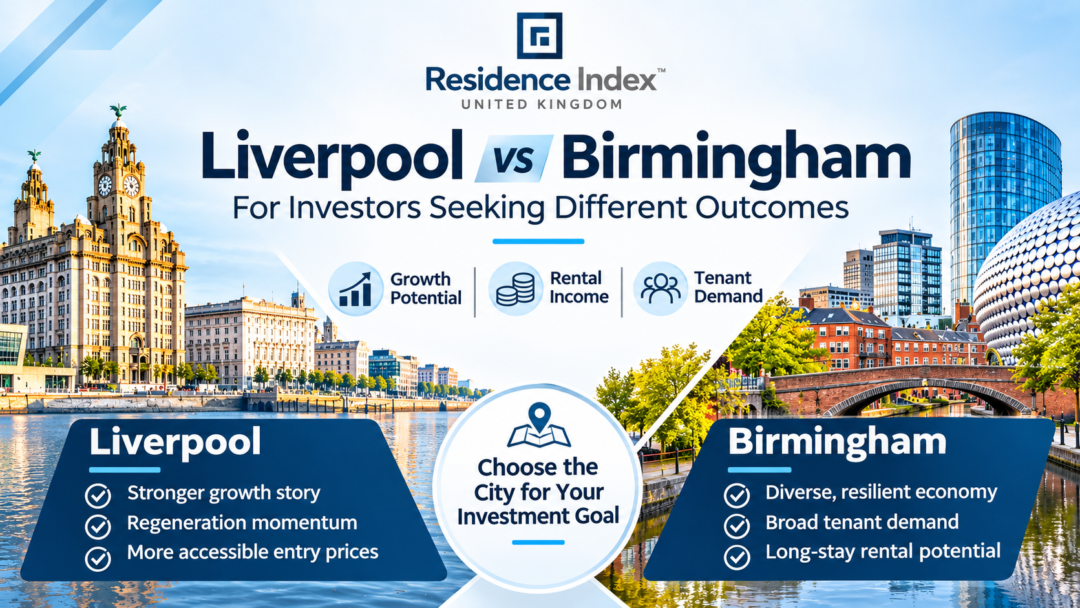
Liverpool vs Birmingham Property Investment: Which Fits?
Liverpool vs Birmingham for Investors Seeking Different Outcomes
Two major UK cities. Two different investment propositions.
Liverpool and Birmingham regularly appear in conversations about regional property investment. Both offer rental markets, regeneration activity and opportunities beyond London.
However, choosing between them should not begin with predictions about which city will deliver the highest returns.
The better question is:
What outcome do you need your next property to deliver?
Some investors prioritise rental income and lower acquisition costs. Others prefer professionally oriented rental markets, premium accommodation or longer-term regeneration exposure.
Understanding the differences between Liverpool vs Birmingham property investment can help investors make more deliberate decisions.
Liverpool vs Birmingham: What the Latest Data Shows
The latest Office for National Statistics figures provide a useful starting point.
Market Indicator | Liverpool | Birmingham |
Average house price, August 2026 | £188,000 | £235,000 |
Annual house price change | +4.7% | +1.5% |
Average monthly rent, September 2026 | £916 | £1,106 |
Annual rent change | +5.4% | +3.3% |
Source: ONS Liverpool Housing Prices and ONS Birmingham Housing Prices, updated 21 October 2026.
Liverpool recorded a lower average purchase price and faster annual growth in both house prices and rents over these reporting periods.
Birmingham recorded a higher average property price and higher average monthly rent.
However, these figures describe different mixes of properties across entire local authorities.
They cannot be used to calculate a reliable investment yield by simply dividing average annual rent by average house price.
For that, investors need actual comparable properties, verified rental estimates and the full cost of ownership.
1. Liverpool: Consider the Income Opportunity
Liverpool may appeal to investors looking for a lower capital entry point or an income-focused investment strategy.
Its property market includes traditional buy-to-let housing, city-centre apartments and accommodation serving different tenant groups.
The relatively lower average purchase price can create opportunities for investors who want to deploy capital across more than one asset.
However, affordability alone does not guarantee a profitable investment.
A lower-priced property may still have substantial maintenance requirements, weak resale demand or unexpected management costs.
Investors should examine:
- Achievable rent from comparable properties
- Tenant demand within the immediate neighbourhood
- Property condition and future maintenance
- Service charges and leasehold obligations
- Management requirements and expected void periods
- Local resale demand
For investors considering short-term accommodation, occupancy, licensing, lease restrictions and operating costs require separate analysis.
Liverpool’s visitor economy is not, by itself, proof that a particular apartment will produce attractive short-let returns.
The objective should be reliable net income rather than the highest advertised gross yield.
2. Birmingham: Consider the Tenant Proposition
Birmingham may appeal to investors seeking exposure to a larger, higher-priced urban property market, particularly within the professional rental segment.
Its city centre offers residential developments aimed at tenants who value connectivity, convenience and amenities.
For some investors, this creates an opportunity to target accommodation that competes on quality and lifestyle rather than simply price.
However, premium accommodation introduces its own considerations.
Higher specification can mean higher acquisition costs, service charges and maintenance expenses.
Amenities such as concierge services, gyms, resident workspaces and landscaped areas can strengthen a property’s appeal.
But their value depends on whether tenants actually use them and are willing to pay for them.
The question is not whether a building looks impressive.
It is whether its rental performance can justify the total investment.
For further context, read Can Premium Birmingham Apartments Attract Long-Stay Tenants?.
3. Regeneration Matters in Both Cities
Regeneration is frequently presented as a reason to invest in regional UK property.
Both Liverpool and Birmingham have significant development ambitions.
In Liverpool, the northern waterfront continues to attract attention through Liverpool Waters and wider regeneration proposals.
The government’s Liverpool City Region Place Delivery Agreement 2026–2027 identifies the North Docks as a major long-term regeneration opportunity.
In Birmingham, the council’s Central Heart Prospectus 2026 outlines opportunities for a new mixed-use city-centre neighbourhood.
Both programmes may influence how particular areas develop.
However, investors should distinguish between completed improvements, funded projects, approved developments and long-term proposals.
Regeneration can improve a neighbourhood without automatically raising the value of every surrounding apartment.
An investment must still work on reasonable assumptions today.
4. Compare Income After Costs, Not Before
A common mistake when comparing Liverpool and Birmingham is focusing on advertised rental yields.
Consider two hypothetical investments:
Property A:
Lower purchase price, attractive gross rental yield, but higher maintenance and management requirements.
Property B:
Higher purchase price, lower gross yield, but a more predictable operating budget and a tenant proposition suited to longer stays.
Neither is automatically better.
The important comparison is net operating income after realistic property-level expenses.
Include:
- Letting and management fees
- Service charges and ground rent, where applicable
- Maintenance and replacement reserves
- Buildings insurance and other landlord costs
- Allowance for vacancy and tenant turnover
- Compliance and administration costs
Then assess mortgage financing, tax and acquisition costs separately to understand the return on invested capital.
A strong headline yield can become disappointing when operational expenses are underestimated.
For another useful framework, read London Capital Growth vs Regional Income: How to Compare.
5. Match the City to Your Investment Objective
Rather than assuming one city is better, investors can compare each market according to the role the property must play.
If Your Priority Is Rental Income
Liverpool may be a useful starting point because of its lower average entry price.
Focus on properties where achievable rent, operating costs and the purchase price support sustainable income.
Do not confuse projected yield with guaranteed performance.
If Your Priority Is Premium Tenant Appeal
Selected Birmingham developments may suit investors interested in professionally oriented, amenity-rich accommodation.
Look closely at comparable rents, tenant affordability, total service charges and the strength of the resale market.
If Your Priority Is Capital Growth
Neither city should be treated as a guaranteed growth market.
Assess the purchase price, local housing supply, comparable sales, regeneration delivery and likely future buyers.
An attractive regeneration story is only one part of the evidence.
If Your Priority Is Portfolio Diversification
Liverpool and Birmingham might serve different functions within a wider UK property portfolio.
However, owning apartments in two cities does not automatically create meaningful diversification.
Consider whether the assets differ in tenant profile, price point, financing exposure and operating requirements.
6. Compare Actual Developments, Not Just City Averages
City-wide data is useful for understanding the market.
But investment decisions happen at building and apartment level.
Residence Index UK currently features examples across both cities.
Liverpool
Westminster Point — a Liverpool residential development with apartments marketed from £170,000.
Portside Place — a Liverpool waterfront development with apartments marketed from £181,000.
Birmingham
Park Residence at Edition — a premium residential development with apartments marketed from £313,000, featuring an amenity-led lifestyle proposition.
These are advertised starting prices, not independently verified market valuations or evidence of achievable returns.
The developments also differ in specification, location, target market and operating considerations.
For each, investors should request up-to-date availability, detailed costs, realistic rental comparisons and independent legal due diligence before making a decision.
7. Five Questions Before Choosing Liverpool or Birmingham
Before committing capital, ask:
- What does my portfolio need most?
Regular income, growth potential, diversification or lower management involvement?
- Who is the likely tenant?
Can local rental evidence demonstrate demand from that tenant group?
- What is the realistic net return?
Calculate the outcome after all recurring expenses and allowances.
- What happens if the market slows?
Stress-test lower rents, longer vacancies, higher borrowing costs and unexpected repairs.
- Who would buy the property from me?
Consider the future resale market, lease terms, mortgageability and competing stock.
These questions are often more useful than a city ranking.
Final Thoughts: Different Cities, Different Investment Roles
Liverpool and Birmingham can both offer opportunities for UK property investors.
Liverpool’s lower average purchase price may be relevant to investors prioritising affordability and income.
Birmingham’s higher-priced city-centre accommodation may appeal to investors targeting premium tenant demand and particular long-term urban investment strategies.
But neither description applies equally to every property.
The strongest investment decision comes from combining market evidence with property-specific financial analysis.
Do not choose a city simply because it is popular. Choose an asset because it performs the job your portfolio needs.
Explore Residence Index UK Properties to compare opportunities across major UK cities.
Or visit the Residence Index UK Blog for more guidance on property investment, rental performance and due diligence.
Disclaimer: This article is for general information only and does not constitute financial, tax or legal advice. Property values and rental income can rise or fall. Official market estimates are subject to revision.