
Profitable Property vs Capital Efficiency | UK Guide
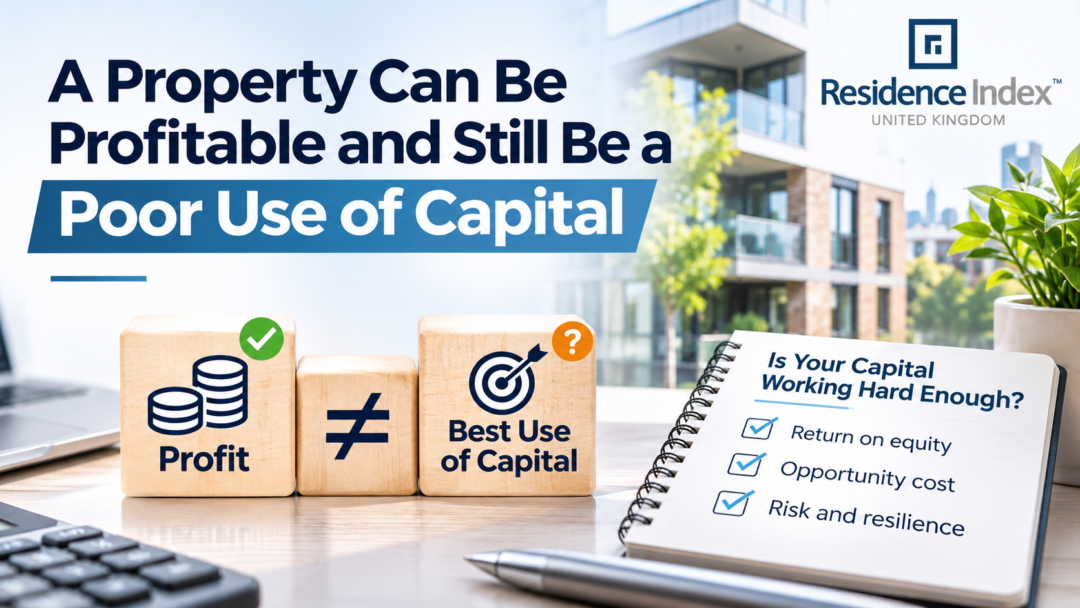
A Property Can Be Profitable and Still Be a Poor Use of Capital
A rental property collects rent every month.
The mortgage is covered.
The tenant pays on time.
The annual accounts show a profit.
From the outside, everything looks successful.
But there is a question property investors should ask more often:
Is this property making the best use of the capital tied up in it?
A profitable property is not necessarily an efficient investment.
That distinction becomes increasingly important as portfolios grow, property values change and new investment opportunities appear.
The objective is not simply to own assets that make money.
It is to understand whether those assets are working effectively for the capital, risk and time they require.
Profitability and Capital Efficiency Are Different
Profitability answers one question:
Does the property generate more income than it costs to operate and finance?
Capital efficiency answers another:
How much return is the property producing relative to the money committed to it?
Imagine two properties.
Property A generates £6,000 annually but ties up £150,000 of investor equity.
Property B generates £5,500 annually but requires £110,000 of equity.
Property A produces more annual cash.
However, its annual cash return on equity is 4%, compared with 5% for Property B.
That does not automatically make Property B the superior investment.
Capital growth, mortgage structure, tenant demand, risk, tax treatment and resale potential may change the comparison.
But the example demonstrates something important.
More profit does not always mean a better return on capital.
Investors need to assess both.
1. Measure the Equity Actually Tied Up
One common mistake is continuing to judge a property only against its original purchase price.
Consider an apartment purchased several years ago.
Its market value has increased.
The mortgage balance has reduced.
The investor now has significantly more equity in the property than when it was first acquired.
Yet the rental income may have grown only modestly.
The property remains profitable.
But more capital is now concentrated in the same asset.
A useful measure is:
Current equity = Estimated market value − Outstanding mortgage balance
Then calculate:
Annual cash return on equity = Annual net cash flow ÷ Current equity × 100
For example:
- Estimated property value: £320,000
- Outstanding mortgage: £170,000
- Current equity: £150,000
- Annual net rental cash flow: £6,000
- Annual cash return on equity: 4%
This simplified example assumes cash flow after routine operating costs and interest-only mortgage payments, before tax.
It is not a complete investment return calculation. Capital appreciation or depreciation, financing principal repayments where applicable, taxes and transaction costs must be evaluated separately.
The 4% figure simply provides a useful starting point.
2. Understand the Opportunity Cost
Every pound committed to one property is a pound that cannot simultaneously be used elsewhere.
That is opportunity cost.
An investor holding £150,000 of equity in a single apartment could potentially have other choices.
Those might include:
- Holding capital in accessible reserves.
- Reducing borrowing elsewhere.
- Acquiring another property.
- Diversifying across locations or asset types.
- Funding improvements that increase rental income.
- Retaining the existing property for income and future growth.
These alternatives involve different risks, returns and costs.
The important point is not that investors should always sell underperforming assets.
It is that continuing to own a property is itself an investment decision.
If you were starting with the equivalent capital today, would you choose to buy the same property at its current market value?
If the answer is no, the reason deserves investigation.
3. Look Beyond Rental Cash Flow
A property might generate reliable monthly income while carrying disadvantages that are less obvious in the accounts.
These could include:
Limited liquidity
A property cannot usually be converted into cash as quickly or cheaply as money held in an accessible account.
Rising ownership costs
Service charges, insurance, repairs, compliance and management costs can reduce future returns.
Concentration risk
A large proportion of portfolio equity may sit in one building, development or location.
Weak exit demand
An asset appealing to tenants might have a narrower resale market than expected.
Operational workload
A property producing an acceptable profit may require disproportionate management time.
This is why our article on comparing investment properties beyond purchase price recommends assessing the entire investment rather than the acquisition figure alone.
4. Compare Returns With Realistic Alternatives
The UK property market is not uniform.
Rental demand, house prices, financing conditions and operating costs differ across locations.
The Office for National Statistics tracks changes in rents and house prices, providing useful market context for investors.
However, national statistics cannot replace evidence for the specific property.
A useful comparison should consider:
- Realistic net rental income.
- Equity or cash invested.
- Mortgage costs and refinancing exposure.
- Capital growth assumptions.
- Service charges and planned expenditure.
- Local tenant demand.
- Selling costs and taxation.
- The ability to access capital when needed.
The Bank of England’s Bank Rate information also offers important context for assessing borrowing costs, although individual mortgage rates will differ.
A higher projected return should never be accepted without examining the additional risk required to achieve it.
5. Do Not Forget the Cost of Changing Investments
Identifying an inefficient use of capital does not automatically justify selling.
Moving capital creates costs.
Depending on the circumstances, those may include estate agency fees, legal expenses, mortgage exit charges, capital gains tax and acquisition costs on a replacement property.
For purchases in England and Northern Ireland, HMRC’s residential Stamp Duty Land Tax guidance explains how the applicable tax depends on the transaction and buyer’s circumstances.
Selling a property that produces a modest but reliable return, only to incur substantial transaction costs, may leave an investor worse off.
The right comparison is not simply:
Current return versus alternative return.
It is:
Expected after-cost, after-tax return from retaining the asset versus the realistic outcome from changing investments.
That calculation should consider an appropriate time horizon.
6. Capital Efficiency Must Include Resilience
There is another important consideration.
The most capital-efficient structure on paper may not be the most resilient.
Using higher leverage can increase returns on equity when conditions are favourable.
It can also increase exposure to borrowing costs, vacancies, falling property values and refinancing difficulties.
Likewise, deploying every available pound into acquisitions may improve apparent capital utilisation while leaving the portfolio short of accessible cash.
Our guide to building a 12-month property cash reserve explains why sufficient liquidity matters alongside investment performance.
Capital efficiency should not mean eliminating every buffer.
It should mean allocating capital deliberately.
7. Five Questions Worth Asking Annually
Investors can make their annual portfolio review more useful by asking five questions.
- How much equity is currently committed?
Use a realistic market valuation and current debt balance.
- What annual cash return does that equity produce?
Calculate income after genuine recurring costs and financing.
- What return is expected beyond rental income?
Assess plausible capital growth, mortgage principal repayment where applicable, and downside scenarios.
- What could this capital achieve elsewhere?
Compare alternative uses on a consistent basis, including risk and tax.
- Would I buy this asset again today?
Consider its current price, condition, lease, location, tenant profile and future resale market.
These questions help reveal whether a property remains suitable for the investor’s objectives.
8. Sometimes the Best Decision Is Still to Hold
Not every property needs to deliver the highest possible return.
Some assets serve important portfolio roles.
A well-located apartment may offer relatively predictable income and lower operational demands.
Another may have a broader resale audience.
An established tenancy may reduce uncertainty.
A property with modest current income could also have credible long-term growth potential.
As discussed in our article on the capital-growth holding trap, investors must also be financially comfortable holding an asset while waiting for its long-term investment case to develop.
The appropriate decision depends on the property’s intended role.
A lower return can be acceptable when it comes with benefits that the investor genuinely values.
But that should be a deliberate choice rather than an unexamined assumption.
Final Thought: A Profitable Asset Is Not Automatically an Efficient One
Property investors often ask whether an acquisition will make money.
Experienced portfolio decisions require another question:
Is this the most appropriate use of my capital, given the alternatives, risks and objectives?
A property can pay its bills, generate positive cash flow and still be a weak allocation of equity.
Equally, a property with a modest cash return may justify its place through resilience, diversification or long-term potential.
The answer comes from measuring the whole investment.
Not just the rent.
Not just the yield.
And certainly not just the profit.
Explore More UK Property Investment Opportunities
At Residence Index UK, we encourage investors to look beyond headline returns and consider how individual assets fit their wider investment objectives.
Explore our UK property opportunities or read more analysis on the Residence Index UK blog.
Important: Property investment involves risk. Rental income, property values and investment returns are not guaranteed. Calculations above are illustrative, not investment forecasts. Investors should seek appropriate independent financial, legal, mortgage and tax advice.